“Gordon, there’s a fellow living in your basement.” I was standing outside our rented winter home in Mesa, Arizona, with a cup of lukewarm coffee in my hand when my neighbor Vern Dahl delivered that astonishing news. The afternoon temperature was eighty-one degrees, a Charley Pride song drifted from somebody’s radio, and the Iowa house my wife and I had left in our son’s care suddenly felt much farther away than fourteen hundred miles. Vern explained that Brett’s girlfriend had moved in around Christmas and that her younger brother was now paying our son $600 a month for a room downstairs. I stared at the lemon tree beside our porch, trying to understand how my thirty-six-year-old son had turned our family home into a source of rental income without asking us. Brett was supposed to check the furnace, run the faucets during severe cold, and keep the sidewalk clear until we returned in May. Instead, he’d apparently moved two people into the house and collected three months of rent. When my wife, Ardis, came back from the swimming pool, I told her what Vern had discovered, and within days we were packing the car for the long drive north—two months earlier than we’d planned.
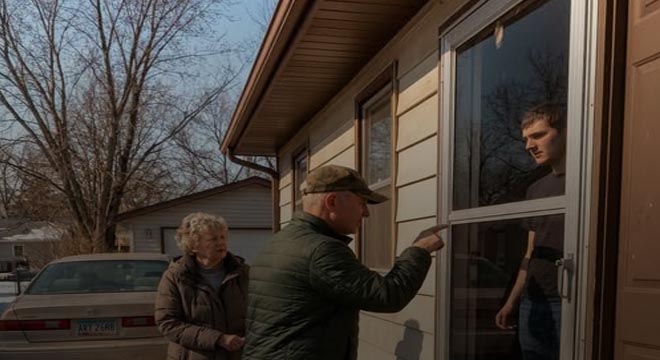
Ardis and I had spent forty-two years together, most of them in a small Iowa town where a person could hardly change the curtains without three neighbors noticing. I’d worked at the grain elevator for forty years before retiring at sixty-three, and after my first miserable winter sitting at home with aching knees, Ardis decided we’d had enough of snow and ice. For six years, we rented the same little park model in Mesa from November until May, coming home each spring in time for Mother’s Day. The arrangement suited us. We enjoyed the warmth, the shuffleboard games, and the company of other retirees who knew exactly what Iowa winters were like. Back home, Vern kept an eye on the house, and someone came around to shovel the walks. Then Brett’s marriage ended, and he moved into a cramped apartment above the old bakery on Main Street. Ardis wondered whether we could help him by letting him use the house while we were away, but I worried that an informal arrangement might create misunderstandings. Eventually we agreed on something limited: Brett would retain his apartment, check our house every few days, protect the plumbing during cold weather, replace the furnace filter when needed, and clear the front walk. In exchange, he could park his truck in our garage during heavy snow. I wrote the instructions on an index card and attached it to the refrigerator, the way I’d recorded household jobs for most of my married life. Nothing about our agreement authorized him to move in, invite other residents, or charge rent. When Vern called that February afternoon, he was careful to explain how he’d learned about the arrangement. He’d encountered a young man at Casey’s convenience store who introduced himself as Austin, the brother of Brett’s girlfriend, Jade. Austin said he was living in our basement and paying Brett $600 a month, which he considered a bargain. Vern had hesitated to telephone us because he didn’t want to interfere in family matters, but he’d known Ardis’s family for decades and believed we deserved to know. After hanging up, I sat beside my wife on the narrow porch of the park model, trying to decide what to do. Ardis suggested calling Brett and asking for an explanation. I refused, not because I didn’t want the truth but because I knew how easily our son could reassure us over the telephone. He’d always been a cheerful talker when something had gone wrong. I wanted to see his face. We considered the consequences of returning early, including the unused weeks on our Arizona rental, the long drive, and the possibility that we’d find a complicated occupancy dispute waiting for us. Someone who’d been living in a house and paying rent, even to a person who lacked authority to collect it, might have legal protections that couldn’t simply be ignored. I had no intention of throwing a stranger’s belongings onto the lawn or involving the sheriff unless it became necessary. Ardis and I decided to go home, talk to everyone, and find a lawful, practical way forward. We spent three days cleaning and closing up the winter place, said goodbye to our friends Don and Lorraine over a supper of tater-tot hotdish, and left Mesa at daybreak on Sunday. The drive took us through Arizona, New Mexico, the Texas Panhandle, Kansas, and finally Iowa. At night, lying awake in unfamiliar motel rooms, I kept calculating the money Brett had collected: $600 in January, another $600 in February, and apparently a third payment at the beginning of March. Eighteen hundred dollars, paid for space he didn’t own. Yet during the drive, Ardis reminded me of something I’d almost forgotten: Brett had never asked us for money since he became an adult. Even after his divorce, when he’d struggled with expenses, he’d insisted he was managing. As we crossed the plains, I began wondering whether the rent was evidence of greed or of a problem he was too ashamed to admit. On Tuesday afternoon, we turned onto our familiar street. Old snow lay gray along the curbs, the big maple in our front yard was bare, and a black pickup I’d never seen before was parked outside our house. Ardis noticed immediately that the walks had been shoveled and salted. Through the living-room window, her African violets were blooming on their usual stand. I reached into my pocket for the house key, then stopped and knocked instead. A young man opened the door, looked at our road-weary Toyota, and asked whether he could help us. I introduced myself as Gordon Brekke, the homeowner. The color drained from his face. “But Brett said this was his house,” he whispered. “He told me you gave it to him when you moved to Arizona.”
- Skin Rash With Breathing Trouble? It Could Be a Life-Threatening Allergic Reaction

A Sudden Rash Could Be a Warning Sign of a Life-Threatening Emergency What begins as a few itchy red bumps could […]
- I Walked Into My Own Restaurant Dressed as a Homeless Man to Test My Staff but I Never Expected Things to End This Way
I hit the sidewalk on my hands and knees. The concrete tore the skin off both palms. My torn thrift store jacket split […]
The young man was Austin Kessler, Jade’s younger brother, and his shock appeared genuine. He explained that he’d lost his apartment when the building’s owner sold the property shortly before Christmas. Brett offered him the finished half of our basement for $600 a month, telling him that he owned the house and that his parents had relocated permanently. Austin had paid in cash, carefully recording each payment in a little notebook. The moment he learned the truth, he offered to pack his belongings and leave that evening. I looked at the snow along the driveway and reminded him the temperature was expected to fall into single digits overnight. “Nobody’s going anywhere tonight,” I told him. He stepped aside and welcomed us into our own home, apologizing repeatedly. Inside, the place was clean, though the familiar rooms smelled of unfamiliar cooking, and a larger television stood where our old one had been. Ardis headed straight for her violets, which were healthier than when we’d left. Her mother’s old Christmas cactus, a stubborn plant that hadn’t bloomed in three years, was covered with pink flowers. Austin explained that Brett watered the plants every Sunday and wouldn’t let anyone else touch them. My anger softened for a moment, but the question of why our son had lied remained. Downstairs, Austin had arranged a simple living space with a cot, a dresser, and a folding table for his laptop. His work boots were lined neatly beside the stairs, and a photograph of his late mother hung above the bed. He worked at an ethanol plant and had been trying to find another affordable place since losing his previous apartment. He showed me the notebook listing his payments to Brett and said he felt foolish for not asking to see evidence that the house belonged to him. I told him the deception wasn’t his doing. Back upstairs, Ardis put on coffee and began quietly reclaiming the kitchen, moving her coffee canister back to the cupboard where she liked it. Jade arrived home from her job as a certified nursing assistant at the local care center around three-thirty. She stopped in the doorway when she saw us, her work bag still over her shoulder. Brett had told her we’d agreed to let her stay while we wintered in Arizona. She’d grown uneasy because he wouldn’t let her answer the house telephone, but she’d believed him when he said everything had been arranged. When I asked where Brett was working that day, she told me he was making deliveries for a feed mill near Garner. I was surprised. For nine years, he’d worked at a cabinet manufacturing plant in Mason City, where he’d become a finishing-line supervisor. Then Jade explained that the plant had laid off most of its second shift on December 12. I remembered reading about the layoffs online and feeling relieved that Brett worked days. What I hadn’t known was that he’d transferred to the second shift months earlier to earn a little extra money. He’d lost his job just before Christmas and hadn’t told either of us. Suddenly, the rent, the moved-in girlfriend, and the hurried efforts to keep us from discovering the arrangement began to look less like a scheme for easy profit and more like a desperate attempt to conceal financial trouble. Brett’s part-time deliveries were unreliable, and he still had a truck payment and regular child-support obligations for his daughter, Emma, from his previous marriage. But understanding the pressure he faced didn’t excuse claiming ownership of our house or taking rent under false pretenses. When his blue pickup appeared outside at five-twenty-five, he spotted our car and stopped in the middle of the street. Through the window, I watched him rest his forehead against the steering wheel, unable for several minutes to get out. He eventually walked to the front door and knocked, something he hadn’t done since he was a child. After greeting his mother, he stood at the kitchen table holding his cap in both hands and said he could explain. I told him I wanted to hear everything, but not in front of the others. I asked him to come for a drive. We went to the grain elevator where I’d spent my working life and parked beside the scale house. The concrete bins rose against the fading sky, and for a while neither of us spoke. Then I told him a story I’d kept private for decades. In 1985, when the elevator nearly closed and farmers across the county were losing their land, I’d gone six weeks without pay. Ardis and I had a mortgage, a baby on the way, and no savings. My father lent us $400 to keep the house payment current. I’d eventually repaid him, but I never properly thanked him because I was ashamed to admit I’d needed help. Brett listened without interrupting. Then he told me about losing his job, trying to keep up with his truck payments, and refusing to fall behind on the $380 monthly child support he owed for Emma. He explained that Jade’s lease had ended, Austin had lost his apartment, and Brett had given up his own rented rooms above the bakery to save money. Our empty house had seemed like a temporary solution. He planned to collect the rent, find steady work, and put everything back before our usual return in May. When Austin asked whether the house belonged to him, Brett had lied because telling the truth seemed harder. Once he’d started, he couldn’t find a way to stop. I asked why he hadn’t called us for help. He looked at the bins where I’d worked for forty years and said, “Dad, you never missed a day of work. How was I supposed to tell you I’d lost my job and couldn’t make my payments?” I told him he could have said exactly that. He paused, then reminded me that I’d kept my father’s loan secret for forty years. I had no answer. For the first time, I understood that the silence I’d always called independence had taught my son to treat ordinary hardship as a disgrace—and that shame had nearly cost us our trust in one another.