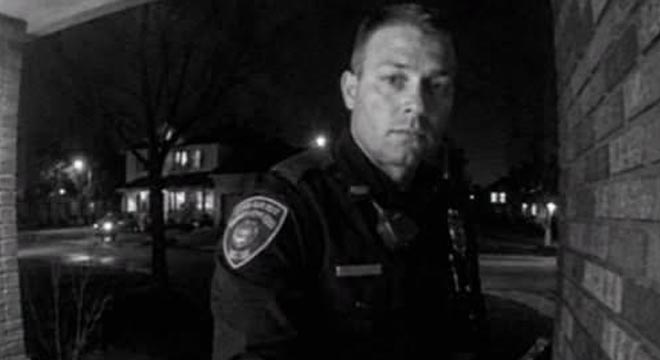
My name is Teresa, and I will never forget the sound a knock makes when it comes at midnight. In the dark, with the house already asleep around you, even the smallest sound becomes something larger than it should be. I had just drifted into that soft, half-forgotten place between waking and sleep when the first knock came, followed by a second, firmer one that made my heart lurch against my ribs. For a few seconds I lay perfectly still, listening to the old pipes in the walls and the faint hum of the refrigerator downstairs, telling myself I had imagined it. Then it came again, harder this time, and I sat up so fast the blanket slid off my legs. By the time I reached the front door, my pulse was hammering in my ears. I looked through the peephole and saw a police officer standing on my porch beneath the yellow porch light, his hat in his hand, his face unreadable. For one ridiculous second I thought maybe there had been an accident on the road or a break-in nearby. But when I opened the door, he did not ask about my neighbors or my street or anyone else at all. He looked straight at me and said my full name as though he had been saying it for years.
“Ma’am,” he said gently, “I’m sorry to bother you this late, but I need to ask you about something from twenty years ago.”
- A Police Officer Knocked on My Door at Midnight – He Asked If I Remembered a Boy from 20 Years Ago
My name is Teresa, and I will never forget the sound a knock makes when it comes at midnight. In the dark, with the […]
- I Discovered My Late Husband’s Dog’s Collar Locket Opens – What He’d Hidden Inside Made Me Sick
My husband Jake died on a Tuesday in late autumn, the kind of gray day that makes even the house feel like it is […]
The words hit me so hard I had to grip the doorframe. Twenty years ago was not a place my mind liked to visit. It was the year I was twenty-six, broke, sleeping four hours at a time, and working nights at a diner off the highway because it was the only job that would take me after my divorce. It was the year I had learned how to smile at truckers, how to refill coffee cups without asking, how to keep my head down and survive. There were a thousand details from that time I had tried to bury, but only one face had ever stayed with me in the way the officer’s question suddenly made clear it still could. I remember my mouth going dry as he opened the folder in his hands and slid out a photograph. The moment I saw the boy’s face, I raised a hand to my mouth without thinking. It was him. Not a man, not a name, but the boy I had not allowed myself to think about in years. His dark eyes, his serious expression, the tiny scar through one eyebrow. I could feel the blood drain from my face.
The officer noticed immediately and stepped back a half pace, as if he had expected that reaction but still wanted to give me room. “You do remember him,” he said.
I did. I remembered him the way you remember a storm that arrived suddenly and changed the shape of a season. His name had been Caleb. He had come into the diner one freezing night in early winter wearing a jacket that was too thin and shoes that were nearly split apart at the seams. He could not have been more than ten or eleven. He sat in the last booth by the window and ordered nothing because he did not have money, and when I brought him a grilled cheese sandwich and hot chocolate anyway, he stared at me like no adult had ever given him anything for free before. He told me his mother had died and his father was “between jobs,” which was the polite way children sometimes describe chaos when they have learned not to say the ugly words. He kept coming back after that, always on the nights when the highway was quiet, always with the same guarded look in his eyes. Some nights he ate. Some nights he only warmed his hands around a cup of soup and asked me what time the buses stopped running. I had suspected, without proof, that home was not a safe place for him. Once, when I noticed bruises on his wrist and a split lip, I tried to call child services, but by the time the call went through he had already stopped coming. The police found his father a few weeks later. There was an arrest, then a move, then a foster placement that I only heard about in pieces from another waitress. Eventually the whole thing faded into the long archive of my life, where painful things go when no one gives them a place to rest.
I opened the door wider and asked the officer why he was asking about Caleb now. That was when he told me he was not there because of the diner, not exactly. He was there because Caleb had just been identified after a cold case investigation tied to an old missing-child report, and the boy in the photograph was now a thirty-one-year-old man who had spent most of his life under a different name. The officer said Caleb had recently come forward with fragments of memory after learning his adopted mother had died, and in one of those memories was a woman at a diner who had once given him food and told him to come back if he ever needed help. The investigator handling the case had tracked down every lead from the town where Caleb had disappeared, and my name had come up in a notebook from a retired social worker who remembered me vaguely from years ago. “We’re trying to piece together his early years,” the officer said, “and he asked whether anyone from the diner might still remember him. We found you first.”
I had to sit down. The officer followed me into the kitchen but waited by the table while I tried to make sense of what he’d said. Caleb had not simply vanished. Years after he stopped coming to the diner, he had been taken out of state by a woman who believed she was his birth mother, only to discover later that the man who raised him had lied about everything. The man had used a fake adoption network, falsified records, and moved Caleb around under a different surname to keep him away from a custody dispute that turned criminal. By the time the truth began to surface, Caleb had already spent most of his childhood in a version of life built on falsehoods. The photograph the officer showed me was from a missing-person file Caleb had only recently seen for the first time, and he wanted to know whether the woman at the diner had been real or just another part of the confusion he had lived inside for twenty years. I told the officer she was real. I told him I had the memory of that boy locked so tightly inside me I had almost convinced myself I had made him up. And then, because grief has a strange way of making honesty easier when it arrives too late to protect anyone, I told him the rest. About the bruises. About the way Caleb used to flinch when a man raised his voice nearby. About how I had once slipped him a bus ticket and told him, in the sort of voice adults use when they are pretending not to be worried, that if he ever needed to disappear, the station was two blocks from the diner and I would not ask questions if he came back.
The officer wrote everything down, but what stayed with me most was the look on his face when I finished. It was not pity. It was relief, because even the smallest witness can matter when a life has been broken into pieces for too long. Before he left, he told me Caleb wanted to know whether anyone had remembered him as kind, because after all those years he feared the only thing people would remember was that he disappeared. I nearly laughed from the ache of it. I told the officer that the boy I remembered was the one who always thanked me too many times, who gave his sandwich crusts to a stray dog behind the dumpster, who once used his last paper napkin to dab coffee off the counter because he thought I might get in trouble for a spill he had made. I told him he had been a good boy, and even now the words felt too small for what they were worth.
Two days later, after I had barely slept and had gone through three pots of coffee, the officer called again and asked whether I would be willing to speak with Caleb directly. I said yes before he even finished the sentence. When he came to my house, he looked exactly like the boy in the photograph and nothing like him at all. The scar through his eyebrow was still there. So was the seriousness in his eyes. But there was steadiness now, and caution, and the kind of sorrow people carry when they have survived something they cannot fully name. He stood on my porch the same way the officer had, but this time when I opened the door he did not wait for a question. He simply said, “I think you knew me when I was invisible.” And I burst into tears before I could answer. He laughed then, softly and awkwardly, because that is what happens when old pain finally meets a face it was never sure would return. I told him I remembered his sandwich order, which made him smile, and then I told him I had once worried about him every time the diner lights went out. He stared at me for a long time after that, and when he finally spoke, he said, “No one ever told me an adult had been looking out for me.” I told him that adults don’t always get to choose whether children remember them, but they do get to choose whether they keep caring.
The investigation uncovered enough to reopen the entire chain of custody around his childhood records, and pieces of his story began to line up in the awful way broken truths do when they have been hidden for too long. Caleb had been used as leverage in a custody fight, then manipulated through forged papers and lies until he no longer knew which family was real. His biological mother had spent years looking for him without ever finding the version of him that survived. The officer who came to my door was not there to accuse me of anything. He was there because one small act of kindness twenty years earlier had become one of the only clean memories left in a life built out of fraud. In the end that is what made me cover my mouth when I saw his face in the photograph. Not because I had done something wrong. Because I recognized, all at once, that the boy I had fed on those cold diner nights had spent two decades trying to crawl back toward the truth, and somehow I had been one of the first people who ever gave him a place to stand.
I still think about that knock at midnight, and how easily I could have opened the door to a stranger and heard nothing but a police question. Instead, I heard the beginning of a story I had not realized I was still carrying. Sometimes life returns to you in the most ordinary way possible, with a porch light, a folder, and a photograph you cannot stop staring at. Sometimes the past does not come to punish you. Sometimes it comes because someone finally found the piece of themselves that was left behind, and wants to know whether anyone remembers.