My son Patrick lost his twin sister, Lily, when they were six years old, and from the day she disappeared, our lives were split into two versions: the one before the pond, and the one after. They had been inseparable in the way only twins can be, finishing each other’s sentences, matching each other’s moods, and moving through the world like two halves of the same heartbeat. One summer afternoon, they wandered down to the pond behind my parents’ farmhouse to feed the ducks, and only Patrick came back. We searched until dark with flashlights and lanterns and the kind of desperate hope that makes a person irrational, but the pond gave nothing back except mud, weeds, and silence. The police eventually called it a tragic accident, and that was the end of the official story, though it was never the end for us. Patrick blamed himself from the start. He would wake up sobbing in the night, clutching his blanket and whispering that he should not have let go of her hand. Therapy helped him speak about it, but it never helped him forgive himself. On the seventh birthday Lily never got to have, he asked me for sunflower seeds because they had been her favorite flowers. “We should still celebrate her,” he said in that small, trembling voice children use when they are trying to be brave for everyone else. So we planted them together.
What began as a way to survive grief slowly became our ritual. Every spring, Patrick and I worked side by side in the garden, pressing seeds into the soil, watering them carefully, and waiting for green stems to push through the earth. Every summer, he would sit among the tall yellow blooms and tell Lily about the year she had missed, as if speaking to her through the petals. He told her when he made the baseball team, when he lost his first tooth, when he finally learned to ride a bike without training wheels, when he got his braces off, when he won the school science fair, when he cried over a bad grade and then recovered, and when he laughed again for real after months of pretending to be fine. The sunflowers became our calendar of survival, one more ring around the tree of our family’s grief each year. Six years passed that way, and by the time the anniversary came again, the garden behind my house had become a wall of gold every summer, as if Lily had somehow left behind her own small sun.
- My Fiance’s 7-Year-Old Daughter Cooks Breakfast & Does All the Chores Every Day — I Was Taken Aback When I Found Out Why

At first, I thought it was adorable that my future stepdaughter, Amila, woke up so early every morning to cook […]
- My Husband Invited a Homeless Veteran to Our 4th of July Barbecue – The Next Morning, 2 Men in Suits Knocked on Our Door Asking One Question That Made My Heart Stop
My husband brought a homeless veteran to our Fourth of July barbecue, and by sunset my children adored him. I thought […]
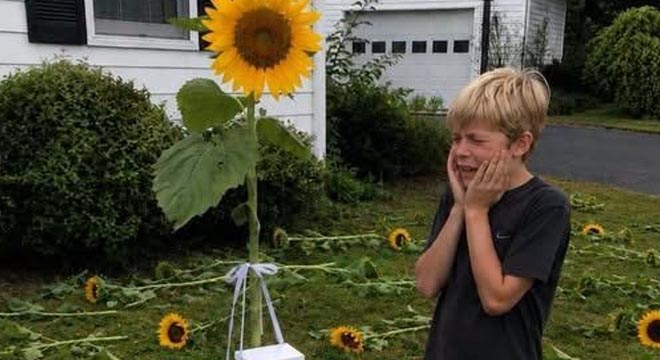
Last Saturday, the sixth anniversary of the day we lost her, Patrick woke up before dawn because he wanted to bring fresh lemonade to the garden before the heat set in. The sky was still pale and soft when we stepped outside, the air cool enough to make the flowers tremble a little in the morning wind. Then Patrick stopped so abruptly the pitcher in his hands tilted and nearly spilled. Every sunflower had been cut down. Every single one. Stalks lay scattered across the soil like broken promises, and the neat rows we had tended for years were ruined in a matter of seconds. Every year of care, every summer of memory, had been reduced to a field of severed stems. Except one. In the middle of the wreckage stood the tallest sunflower we had ever grown, impossibly untouched, rising above the others like a sentinel. Hanging from its stem by a white ribbon was a small white box, no bigger than a jewelry case, swaying lightly in the breeze as if it had been waiting for us. Patrick’s face went white. “Mom,” he whispered, his voice so thin it barely reached me. “Who would do this?” I could not answer. My hands were shaking too hard to untie the ribbon properly, and my own pulse sounded loud in my ears. There was no note, no explanation, nothing but that box and the awful certainty that whoever had left it there knew exactly what it meant to us.
I opened the lid. Inside was a tiny silver duck charm, the kind sold in souvenir shops near county lakes, attached to a blue ribbon that had frayed at the edges from age. Beneath it was a folded piece of paper. The moment I saw the handwriting, the world tilted beneath me. It was my sister’s. Not my daughter’s. My sister Mara’s. Six years earlier, Mara had been the only adult who insisted something about Lily’s disappearance never fit. She had been the one person willing to say, quietly and repeatedly, that the official search had been too fast, too clean, too ready to settle on an accident. I had been angry with her then because grief makes enemies out of people who ask difficult questions. But now, standing in my ruined garden with Patrick beside me, I unfolded the page and read the words my knees had been too weak to expect. I found her, it said. Not Lily. Not a body. A trail. And the trail led where your husband told everyone not to look. The note went on to say that Mara had never stopped investigating the pond, the old shed behind the farmhouse, the property records, the names of men my husband’s family knew but never mentioned, and the strange gaps in the timeline from that summer. Under the note was a second page, a copy of an old police report with sections highlighted in yellow, along with a new date stamped across the top from only two weeks earlier. Someone had reopened the case.
My husband, Ethan, arrived before I could even make sense of the papers, called by the noise of Patrick crying out behind me. He took one look at the box in my hands and went rigid. That was the first moment I understood that the story we had believed for six years was not just incomplete. It was false. Ethan had told me for years that he had already gone over every inch of the property with the sheriff, that there was nothing else to find, that we had to let Lily rest. But when Patrick asked him why the report in my hand had his signature on the witness statement, Ethan’s mouth opened and nothing came out. The silence that followed was not the silence of innocence. It was the silence of a man who had been cornered by the one truth he never thought would surface. Mara stepped out from behind the orchard gate then, and for one awful second I thought I might collapse from shock alone. She had returned from the city without telling me, and standing with her were a private investigator, a county detective, and a woman I did not recognize, all of them carrying folders and photographs and the sort of grim expression that means a lie has finally outlived itself.
What came next was not tidy, and it was not kind, but it was the truth. Lily had not drowned in the pond. She had been taken. The small duck charm had belonged to her, and the blue ribbon had been tied to her wrist by Mara years ago, the day she vanished from a foster placement my husband had claimed was only temporary. Ethan’s brother had been involved in the arrangement, along with a man who worked for the family farm lease company and knew exactly how to move a child quietly without leaving a trail that anyone believed. The official story of a pond accident had been constructed because it was easier, because a frightened little boy who came home alone was considered less useful as a witness than an “accidental” tragedy, and because my husband had wanted the matter buried before anyone asked why Lily had been moved away from the family home in the first place. The lie was so much larger than I could absorb in one breath. Patrick stood frozen as Mara explained that she had followed a paper trail nobody else thought worth chasing, and that only days ago she had found enough to reopen the case and force the first real search in years. The box had not been left by a stranger. It had been left by Mara as a signal to us that someone was finally looking where the truth had been hidden.
When the detective opened his folder and showed me the photographs, the room inside my head went cold and empty. There were pictures from a roadside motel three towns away, surveillance stills of a girl with Lily’s eyes at fourteen, then sixteen, then a young woman standing in line at a bus station with her hair pulled back and her face turned away. There was no question anymore that Lily had lived. She had survived. The reason I nearly collapsed was not because I was being told my daughter had died, but because I was being told she had been alive somewhere while the people around me built a false grave around her name. I sank onto the porch steps because my legs refused to hold me, and Patrick knelt beside me with his face streaked with tears and asked the one question that split me open completely. “Why didn’t they bring her back?” I had no answer that could fit inside the truth we had just uncovered. I only held him while the detective explained that the case was moving fast now, that the woman in the photographs was almost certainly Lily, and that if the trail held, we might finally see her again.
By evening, our ruined sunflower garden no longer felt like a graveyard. It felt like a summons. The white box, the charm, the reappearing evidence, the reopened file, all of it pointed toward a truth that had been buried under grief and fear for far too long. Patrick kept the duck charm in his palm until his fingers stopped shaking. He said Lily had always loved ducks because she thought they looked like they were hurrying somewhere important, and for the first time in years, he smiled through tears instead of only crying through them. I did not know yet what kind of woman she had become, or whether the sight of us would feel like rescue or intrusion. I only knew that the story we had survived for six years was a lie, and that the life we had mourned might still be waiting somewhere beyond it. As the sun went down behind the farmhouse, I looked at the single surviving sunflower in the middle of the cut stems and understood why it had been left standing. It had not been a taunt. It had been a message. The truth, like that flower, had been cut down everywhere except where it was strongest. And now, finally, it was about to bloom.