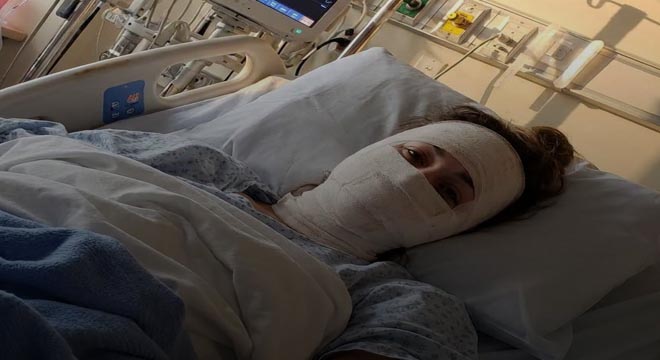
“Mom, there’s something wrong with my heart. They have to operate tomorrow.” My twenty-one-year-old daughter’s voice broke through the telephone at 9:40 on a Tuesday night while I stood at the kitchen sink, my hands still wet with dishwater. Emily was sobbing so hard that I could barely understand her, but I caught the words heart surgery, emergency, and twenty-four thousand dollars. Within minutes, I was driving north through the darkness toward a private clinic near her university, gripping the steering wheel and praying I would reach her in time. I arrived at Westbrook Surgical shortly after four in the morning and spent hours waiting beneath the harsh lights of a room that looked more like an expensive hotel lobby than a hospital. When a nurse finally led me to Emily’s recovery room, my knees nearly gave way. Her face was wrapped in thick gauze, purple bruises darkened the skin beneath her swollen eyes, and a plastic splint covered her nose. She claimed she’d suffered an allergic reaction during surgery, but when I asked to speak with her surgeon before paying the remaining $14,600, I discovered there had never been anything wrong with her heart.
My name is Diane Walsh. I’m fifty-two, and I’ve spent twenty-six years working as a dental hygienist, most of them while raising Emily alone. Her father, Greg, left when she was five, eventually moving to Arizona and becoming the sort of parent who remembered birthdays only when someone reminded him. Emily and I built our own routines: Saturday pancakes, drives to nature centers, Christmas decorations we never took down before New Year’s, and long conversations at the kitchen table. She loved wildlife from the time she was little, and I spent countless afternoons pretending to be as fascinated by salamanders as she was. When she was accepted into Halston University to study environmental science, I was proud enough to cry in the grocery store. She wanted to work for the National Park Service someday, and I’d spent years taking extra shifts to help make that dream possible. Some months I managed to put only fifty dollars into her education account; other months, when work was plentiful, I saved two hundred. Scholarships and those savings covered much of her first two years, while Emily worked ten hours a week at the campus library to help with rent and groceries. She was sensible with money, or so I believed. This was a girl who once returned a sweater after finding it eight dollars cheaper online. Over the previous several months, however, our conversations had become shorter. She complained of exhaustion, headaches, and trouble sleeping, but whenever I suggested visiting, she insisted she was busy with assignments. She avoided video calls and rarely sent photographs. At Thanksgiving, she wore an oversized gray hoodie almost constantly and disappeared whenever someone brought out a camera. I assumed she was simply adjusting to the pressures of university life. Then came her frantic telephone call about a life-threatening heart condition. She told me a private clinic had scheduled urgent surgery for the following morning, that the procedure would cost almost $24,000, and that she’d already paid a deposit. I was frightened enough to promise help before asking to see a diagnosis or speak with a physician. During the drive, I replayed every conversation in which she’d mentioned feeling unwell, wondering whether I’d dismissed symptoms that should have alarmed me. At a gas station after one in the morning, I called Westbrook Surgical and was told that staff couldn’t discuss an adult patient’s medical information without authorization. I accepted that because I understood the importance of patient confidentiality, but I clung to the receptionist’s assurance that Emily was resting comfortably. When I finally reached the clinic, a nurse told me she was already in preoperative care and couldn’t receive visitors. At 6:30, staff informed me that the procedure had begun. By late morning, Emily was in recovery. I hurried to her room expecting to hear about cardiac complications and surgical treatment, only to find her face almost entirely bandaged. She said her skin had reacted badly during the operation and begged me not to ask questions because she was in pain. Then she asked me to pay the outstanding balance downstairs. I agreed to speak with billing but insisted on understanding what had happened first. The surgeon, Dr. Alan Prescott, appeared surprised when I mentioned an emergency heart procedure. He asked whether Emily had discussed the treatment with me, then explained that he couldn’t share her private medical details without her permission. His reaction was enough to send me back upstairs. I asked Emily directly whether she’d undergone heart surgery. After a long silence, she whispered, “No, Mom. I had my face changed.”
- Skin Rash With Breathing Trouble? It Could Be a Life-Threatening Allergic Reaction

A Sudden Rash Could Be a Warning Sign of a Life-Threatening Emergency What begins as a few itchy red bumps could […]
- I Walked Into My Own Restaurant Dressed as a Homeless Man to Test My Staff but I Never Expected Things to End This Way
I hit the sidewalk on my hands and knees. The concrete tore the skin off both palms. My torn thrift store jacket split […]
I sat beside her bed, staring at the daughter I’d driven through the night to reach. Emily told me she’d undergone cosmetic surgery on her nose and chin, procedures she’d planned for weeks but had been too ashamed to discuss with me. With her permission, Dr. Prescott returned and confirmed that he’d performed a rhinoplasty and chin reduction. The swelling, bruising, and facial dressings were normal postoperative effects, not evidence of an allergic reaction. Emily had consulted him two months earlier and scheduled the operation six weeks before it took place. There had been no emergency, and she had not been diagnosed with a heart condition. According to the surgeon, she’d told the clinic that her
family supported her decision, and as an adult she’d completed the required consent documents herself. After he left, I asked where she’d found the money. She admitted she’d used nearly $10,000 from her personal savings, including wages from her campus job and money I’d given her for living expenses, as the initial payment. The remaining amount had been financed through the clinic. I thought about the years I’d worked Saturdays so she could graduate without excessive debt, then looked at her frightened eyes and struggled to understand why she’d risked her education to change her appearance. When I asked why she hadn’t told me, she said she knew I’d object. I told her asking questions wasn’t the same as refusing to understand. For a long time, she lay facing the window while I sat in silence. Then I remembered the missing photographs, the hoodies, and her growing reluctance to speak on camera. I asked whether something had happened at school. Emily began crying, and the explanation came in fragments. Months earlier, someone had taken an unflattering photograph of her laughing at a party. It circulated through student group chats, where people mocked her nose and chin. Someone edited the image to exaggerate her features, and the cruel version spread even farther. Students made jokes when she passed them in the dining hall, imitated her laugh, and drew insulting pictures near her dorm room. Emily withdrew from social activities, stopped posing for photographs, and began taking longer routes to class to avoid encountering people who recognized the image. She’d been humiliated so often that eventually she couldn’t bear to look at herself without hearing their comments. When I asked why she hadn’t told me, she said I’d probably have dismissed the students as immature and advised her to ignore them. I knew she was right about the advice I would have given, and I understood why it might have felt inadequate to someone who had to see those people every day. I held her hand and asked who had helped her through the bullying. She said her boyfriend, Ryan, had been her greatest support and had even helped her find Dr. Prescott. I’d met Ryan twice and found him charming, polite, and ambitious. He was studying with the intention of attending law school, and he’d always been respectful in my presence. Still, something bothered me when Emily described how strongly he’d encouraged the surgery. I asked whether he’d ever reassured her that she didn’t need to change her appearance to deserve affection. She hesitated before saying he wanted her to be happy. I didn’t press further while she was recovering. The following morning, I helped her check out of the clinic and moved us into a hotel near campus so I could assist with her postoperative care. I declined to pay the remaining surgical bill without first reviewing her financing agreement, and I made it clear that agreeing to care for her did not mean accepting responsibility for a debt she’d taken on through deception. At the hotel, I bought soft food, cold packs, and the supplies listed in her discharge instructions, then settled beside her while she rested. That afternoon, Ryan called. He seemed uncomfortable when he learned I knew about the surgery, and when I asked whether he’d known Emily planned to tell me she was undergoing emergency heart treatment, he avoided answering directly. Later, Emily showed me their messages, hoping to prove he’d been supportive. Some were affectionate, but others repeatedly promised that after surgery she would finally be comfortable appearing in public again. One message suggested they could begin socializing with his friends once she’d changed her face. I asked why he was continuing to go out with those friends while Emily stayed home. She said they’d decided it would be easier until the bullying stopped. The answer unsettled me. Then Emily revealed that she’d stopped speaking to Maya, her former roommate and closest friend, because Maya had accused Ryan of talking about her behind her back. With Emily’s permission, I called Maya, who said she’d kept screenshots from the student group chat where the original photograph had circulated. At first, Ryan had defended Emily. But after his friends teased him about dating her, he’d begun laughing along and eventually contributed his own jokes about her appearance. In one message, he mocked her chin; in another, he reassured the group that she was working on fixing her looks. Emily stared at the screenshots, unable to reconcile them with the boyfriend who had encouraged her to visit a cosmetic surgeon. That night, we reviewed months of their conversations. His early messages had urged her to ignore the bullying, but gradually he began suggesting makeup techniques, sending photographs of models, recommending cosmetic consultations, and implying their relationship would improve once she felt confident enough to be seen with his friends. He knew she’d be using money intended for college, yet encouraged her not to delay. Near midnight, Emily found a message in which she’d asked whether Ryan would still love her if she never changed her face. He’d replied that he loved her but wished she’d do something about the insecurity affecting their relationship. She put down the phone and began to sob. The surgery she’d undergone wasn’t simply an attempt to escape cruel strangers; it was a desperate effort to keep the affection of someone who had quietly joined in their cruelty.