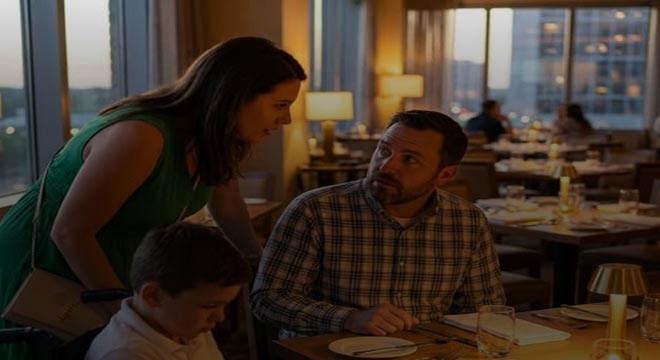
“Move him somewhere else,” the woman demanded, pointing at my nine-year-old son’s wheelchair. “It’s ruining everyone’s meal.” The clatter of cutlery seemed to stop all at once, and I could hear the soft scrape of my husband Ben’s chair as he pushed back from the table. Liam had been halfway through a joke about chocolate cake, but now he stared at his chicken tenders, gripping his fork until his knuckles turned white. Behind him, the evening sunlight spread across the lake beyond the restaurant windows, turning the water a beautiful shade of pink that suddenly seemed cruelly out of place. I caught Ben’s wrist before he could confront her and rose from my chair instead. For five years, we’d worked to help our son feel confident navigating a world that too often made simple things unnecessarily difficult, and I wasn’t about to let a stranger convince him that he was unwelcome at dinner. But when I looked into his eyes and heard him whisper that we could always eat upstairs, I realized this wasn’t simply an argument about a wheelchair or the space between restaurant tables; it was a moment that could change how Liam saw himself.
My name is Ella, I’m thirty-eight, and I work as a school librarian in Columbus, Ohio. Ben and I have spent the past five years rebuilding our family life after a car accident left Liam with a spinal cord injury at the T10 level when he was four. Ben had been driving him home from a
birthday party on a rainy October afternoon when a pickup truck ran a red light and struck the rear passenger side of our car. Ben survived with minor injuries, but Liam lost the ability to walk. Six weeks in the hospital were followed by four months of rehabilitation, during which our little boy learned to sit upright again, transfer safely, and maneuver his wheelchair independently. He adapted with a determination that astonished us, although Ben continued carrying guilt about the crash despite having done nothing to cause it. I could see it whenever he hesitated before driving or reached automatically toward Liam’s chair, afraid that something else might happen if he wasn’t close enough to intervene. For years, most of our trips had been to specialists, therapy appointments, or relatives’ homes. A proper family vacation seemed complicated, requiring careful checks of door widths, ramps, elevators, accessible bathrooms, and the space available in restaurants. When we finally booked a lakeside resort in northern Michigan, I spent three months confirming the facilities, even asking the reservations manager to send photographs of the bathroom and pool lift. Liam thought I was being ridiculous. He said a vacation didn’t have to be perfect as long as there was chocolate cake. On our first afternoon, he raced Ben along the fourth-floor corridor, laughing as his father worried about the furniture and threatening to charge taxi fare if anyone tried to push his chair without permission. When the elevator doors began closing, Liam pressed the button himself and rolled inside, proudly proving that he could manage without assistance. In the elevator, Ben admitted quietly that he sometimes still heard the sound of the crash in his head. Liam reminded him that parents were allowed to feel frightened but that he needed room to do things independently. Later, at the resort pool, a young lifeguard named Tyler showed Liam how to operate the accessible lift, and he spent two glorious hours swimming and racing his father. Watching them, I felt something in our family relax for the first time in years. That evening, we arrived for our six-thirty dinner reservation at the resort restaurant, where white tablecloths, candles, and enormous windows overlooked the lake. The manager, Jeff, welcomed us warmly and removed a chair from our table so Liam could roll into place without difficulty. Liam checked the clearance himself, declared it perfect, and immediately opened his menu to the dessert section. We ordered chicken tenders for him, steak for Ben, and salmon for me. For several precious minutes, we were simply a family enjoying a holiday, with no medical appointments or equipment concerns to interrupt us. Then Liam shifted his wheelchair slightly while reaching for the bread basket, and one wheel brushed an empty chair behind him. The chair moved barely an inch. He apologized immediately, but a woman at the neighboring table turned toward him and told him to be more careful. She appeared to be in her early sixties, dressed elegantly in a cream blouse with pearl earrings. Although there was ample room in the aisle, she complained that Liam was blocking the passage and stopped a young server named Rosa to demand that we be moved. Rosa checked the space, confirmed that the arrangement was suitable, and politely declined. Ben was furious, but I reminded him that Liam had already apologized and that the employee had handled the complaint. We tried to return to dinner. Liam had just begun telling another joke when the woman scraped her chair backward, approached our table, and announced that our son’s wheelchair was ruining everyone’s meal.
- My Daughter-in-Law Accused Me of Breaking Our $40 Christmas Gift Rule — Then My Granddaughter Found a Letter Hidden Inside the Box
“This is not a forty-dollar gift,” my daughter-in-law announced, raising a small wooden box above her head as […]
- Massive Back Lipoma

1.Dear reader, the video is a little lower. Acne also known as acne vulgaris, is a long-term skin condition that occurs […]
I stood beside Liam, looking directly at the woman, who later introduced herself as Cindy, and asked her to repeat what she’d said. She insisted that the chair occupied too much space and that other guests had come to enjoy a pleasant evening without disruption. When she referred to the wheelchair as “that thing,” Liam lowered his head and suggested that we leave. I knelt beside him so we could speak face-to-face and asked whether he’d deliberately done anything wrong. He told me that he’d touched the empty chair by accident and apologized, and I reminded him that Rosa had already confirmed the aisle was clear. I told him we could remain at our table if that was what he wanted. He nodded, although his eyes were wet. I stood and made a note of Cindy’s exact words on my phone, not to create a spectacle, but because I didn’t want the encounter misrepresented later. Ben rose beside me, visibly shaking with anger, until Liam quietly said, “Dad,” and he sat down again, placing a reassuring hand on the arm of the wheelchair without trying to move it. By then, Rosa had fetched Jeff, the restaurant manager, who approached and greeted Cindy with the familiarity of someone who had known her for years. She immediately accused us of causing a disturbance and claimed Liam had nearly struck her. Rosa corrected the account, explaining that his wheel had touched an empty chair, that he’d apologized, and that there had never been a problem with the aisle’s clearance. Jeff initially offered us a quieter table, apparently hoping to resolve the confrontation without further distress. I appreciated his concern but explained that moving us would make Liam feel responsible for someone else’s behavior. When Jeff asked what Liam preferred, my son said clearly that he wanted to stay where he was. Jeff agreed. Cindy continued insisting that she spoke for the other diners, so I asked whether anyone had actually been prevented from walking through the aisle or enjoying their meal. Several guests answered that they had seen servers pass without difficulty and that Liam hadn’t disturbed them. Cindy’s face reddened, and she accused me of embarrassing her. I reminded her that she’d approached a child in public and suggested that his mere presence had spoiled the evening. It was not a question of whether the wheelchair was convenient for her; Liam had a right to occupy the accessible space provided for him, and the restaurant had confirmed that the arrangement was appropriate. Resort dining facilities open to the public are generally subject to accessibility obligations, and a guest’s dislike of seeing a wheelchair does not provide a legitimate reason to exclude someone. Jeff turned toward Cindy and instructed her to return to her table. Just then, two younger guests entered carrying a bakery box and a small gift envelope. A man in his thirties, dressed in a navy jacket, stopped when he saw the tension and asked his mother what had happened. Cindy quickly claimed that our family had attacked her. But Liam raised his head and explained in a small, clear voice that he’d accidentally touched a chair and said he was sorry. Jeff described Cindy’s subsequent remarks, and the young man’s expression changed from confusion to disbelief. His name was Daniel, and he was a physical therapist who worked with adults and children recovering from serious injuries. When he learned that his mother had told a nine-year-old boy his wheelchair was ruining dinner, he asked how she could say something so cruel after seeing the challenges people with mobility impairments faced. Cindy protested that he’d misunderstood, then demanded that he stop lecturing her in front of strangers. Daniel answered that she had chosen to humiliate a child in front of those same strangers. His fiancée, Maya, stood nearby holding the cake they’d brought to celebrate their engagement. Cindy pleaded with them not to ruin the occasion over what she called a misunderstanding, but Daniel refused to pretend that her conduct was harmless simply because she was his mother. When she accused him of choosing strangers over family, he replied that he was choosing not to excuse behavior he knew was wrong. She finally offered a stiff apology for upsetting Liam, but I asked her to acknowledge her own words rather than blame his reaction. After a long silence, she turned to him and admitted that saying his wheelchair was ruining dinner had been cruel and untrue. Liam studied her for a moment before answering, “Okay.” He didn’t smile or reassure her, and I didn’t ask him to. Jeff then told Cindy that, despite her apology, she would have to leave the restaurant because her treatment of another guest violated the standards he expected in his dining room. She collected her purse and walked out alone. Nobody applauded, and I was grateful. My son’s humiliation was not a performance, and I didn’t want his pain turned into entertainment. When Cindy had gone, Daniel and Maya approached to apologize for the incident. Daniel acknowledged that he’d ignored smaller prejudiced remarks from his mother over the years because confronting her was uncomfortable. He regretted letting that habit continue. Maya gently offered Liam some of their chocolate engagement cake, and his solemn expression changed as he asked whether the frosting was chocolate too. When she assured him it was, he declared the arrangement acceptable. For the first time since the confrontation began, Ben laughed, followed by Liam. Jeff brought additional chairs and clean plates, making sure the aisle remained clear, and Daniel and Maya joined us for dessert. They asked Liam to finish the joke he’d been telling before Cindy approached. It wasn’t particularly funny, but we laughed together, relieved to have recovered at least part of the evening we’d nearly lost.
Back in our room that night, Liam was unusually quiet. Ben helped him transfer from his wheelchair to the bed, then went into the bathroom, where I could hear the water running for a long time. I sat beside Liam and asked how he was feeling. He wanted to know why Cindy had said those things when he hadn’t done anything to her. I told him that some people respond unkindly to differences they don’t understand, but that her discomfort was not his responsibility. He admitted that he’d wanted to leave the restaurant simply to make the confrontation stop. I understood why; I’d felt the same impulse myself when I saw how hurt he was. But we talked about the difference between choosing to leave because he wanted to and feeling forced out because someone had decided he didn’t belong. Later, Ben came from the bathroom with red eyes and sat on the other side of the bed. He apologized for nearly losing his temper, explaining that ever since the accident he’d been terrified of failing to protect Liam. Our son reached over and rested a hand on his father’s. “It wasn’t your fault,” he said quietly, reminding Ben that another driver had run the red light. Ben began crying, something I’d rarely seen him do, and Liam kept his hand there until his father regained his composure. Then he added that Ben still wasn’t allowed to grab the wheelchair handles without asking. Ben laughed through his tears and promised to work on it. The following morning, I was reluctant to return to the restaurant, but Liam was already at the door announcing that he wanted waffles. He rolled into the dining room ahead of us, and Jeff greeted him at the entrance before removing a chair from the same table we’d occupied the night before. This time, he asked Liam directly whether there was enough room. Liam checked the clearance and pronounced it perfect. Daniel and Maya arrived soon afterward and asked whether they might join us, and I let Liam decide. He welcomed them, and over breakfast Daniel told him that his mother’s comments had been wrong and that Liam should never have needed an entire room of strangers to confirm his place in a restaurant. My son continued cutting his waffle, then said something I’ll never forget: “I already knew I belonged. I just forgot for a minute.” Daniel smiled sadly and admitted that everyone forgot important things sometimes. Later, the couple invited Liam to play cards on the patio. Ben almost answered for him, but caught himself, allowing Liam to accept the invitation. He proceeded to beat them at Crazy Eights four games in a row, announcing that confidence was part of his vacation strategy. As we headed back toward the elevators afterward, I saw Ben’s hand drift toward the handles of Liam’s wheelchair. He stopped, tucked it into his pocket, and walked beside him instead. Liam noticed and told his father that he was learning. When the elevator doors began closing, Ben didn’t rush forward. Liam pressed the button, rolled inside, and turned neatly to face us. “See?” he said, smiling. Ben nodded, and I could see how much effort that simple act of trust had required. Three months later, we received a card from Daniel and Maya announcing that they were getting married in June and asking whether Liam would serve as their ring bearer. He read the invitation several times, immediately wanting to know whether the ceremony aisle would be wide enough for his wheelchair and whether the reception would feature chocolate cake. He wrote his acceptance himself, proudly describing himself as a professional driver and requesting enough space to carry the rings safely. At the bottom, he added a question about whether Daniel’s mother would attend. Daniel replied that she would and that she’d asked him to convey her thanks for the reminder she’d received that evening. Liam read the message, considered it briefly, and returned to his dinner. “Good,” he said. “She can sit at my table.”
I have thought often about that evening at the resort, particularly how quickly an ordinary family dinner became a test of whether my son would feel free to occupy the space he’d been given. Before the incident, I’d spent so much time preparing accessible arrangements that I’d begun to believe good planning could protect us from every unpleasant surprise. I could measure doorways, confirm a pool lift, inspect hotel bathrooms, and request a table with adequate clearance, but I couldn’t predict another guest’s behavior. Nor could I control how Liam would feel when someone told him that his presence was unwelcome. What Ben and I could do was listen to him, respect his choices, and support him when circumstances made those choices difficult. That’s something we’ve continued learning since our trip. At home, Liam still makes terrible jokes about food, races his father down hallways when there’s enough room, and asks for dessert before we’ve finished discussing dinner. Ben remains careful, especially in unfamiliar places, but he now asks before helping with Liam’s chair instead of instinctively reaching for it. Sometimes he still struggles. Sometimes I do too. Five years of caution don’t disappear after one good conversation, any more than one ugly encounter erases a child’s confidence forever. Yet I can see the difference in how our family approaches new experiences. Liam has become more comfortable explaining what he needs and saying when he doesn’t want assistance. Ben is learning that allowing our son greater independence is not the same as leaving him unprotected. And I am learning to distinguish between speaking up for Liam when he needs support and speaking over him when he is capable of answering for himself. The wedding invitation now rests on our refrigerator, held in place by a magnet Liam made at school. He checks it occasionally and asks questions about the ceremony, especially where he’ll enter and whether the rings need to be tied securely to a cushion. He has also drawn a detailed picture of the chocolate cake he hopes will be served. I don’t know how Cindy will behave when we see her again, or whether the conversation with Daniel changed her understanding of what happened. I hope it did, though I don’t expect Liam to carry responsibility for that change. What matters to me is that he has not allowed the incident to make his world smaller. He remembers the kindness of Rosa, who calmly confirmed the aisle was clear; of Jeff, who ultimately supported his wish to stay; and of Daniel and Maya, who treated him as a boy with opinions, humor, and plans rather than as a problem to be managed. He remembers the cake, the card games, and the way his father finally let him approach the elevator without rushing to intervene. Last week, while we were discussing the wedding, Liam asked whether I thought he’d be able to roll all the way down the aisle without anyone helping him. I told him we would check the venue and make sure the route was accessible, then asked what he wanted. He considered it for a moment and said he wanted to do it himself, unless something unexpected happened. I promised we’d be nearby if he needed us. He nodded, satisfied, and returned to drawing his cake. Watching him, I thought back to the restaurant where he’d lowered his head and offered to eat upstairs because someone else wanted him out of sight. That frightened little moment is not the whole story of our vacation, and it will not define the places he chooses to go. There are classrooms, restaurants, offices, celebrations, and countless ordinary afternoons ahead of him. Some spaces will be welcoming, and others will require people to do better. Liam will decide when to ask for help, when to speak up, and when to keep moving. Ben and I will be close enough to support him, but increasingly, we will be walking beside him rather than trying to guide every turn.