It started the way the scariest things always do—like it belonged in the middle of an ordinary day.
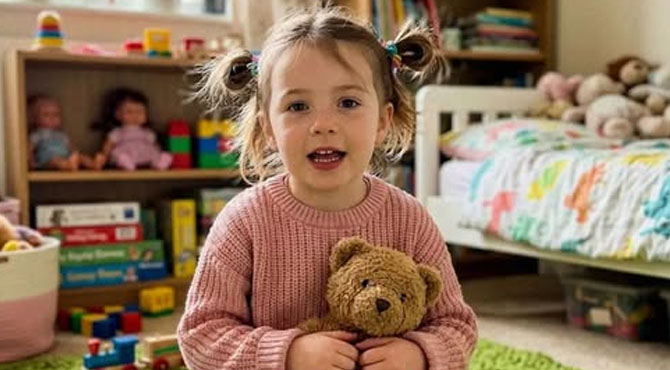
Ellie was at the table in her pajamas, spooning Cheerios with the same serious concentration she gave to coloring books and puzzle pieces. I was half-awake, one hand around my coffee mug, mind already racing through work emails.
- Part 2: “He’s Bit Three Volunteers. Nobody Goes In That Kennel.” I Opened the Door Anyway — and the Dog Wasn’t Guarding Rage.
When I moved closer to the doghouse, Bishop did not bite.He pressed his body sideways against the opening and trembled […]
- I planned everything — even my dad’s favorite dessert. My parents texted:
By the time my mother’s message came through, everything had already been handled with the kind of precision I’d […]
Without looking up, she said, completely casual:
“Mr. Tom thinks you work too much, Mommy.”
My mug paused midair. “Mr. Tom?”
Ellie shrugged like I was the one being strange.
“He checks on me!”
I forced a little laugh and told myself what any tired parent tells themselves—imaginary friend. Kids name everything. Her stuffed rabbit was Gerald. Her blanket was Princess Cloud. Of course she had invented a “Mr. Tom.”
I let it go.
That was my first mistake.
A week later, I was brushing her hair before bed. We were both facing the bathroom mirror, her head tipped slightly back as I worked through a knot. Ellie frowned at her reflection like she was trying to solve something.
Then she asked, in the calm voice of a child who doesn’t realize she’s ripping open the floor beneath you:
“Mom, why does Mr. Tom only come when you’re asleep?”
The brush stopped.
“When I’m asleep?”
“He comes at night,”
she said, like this was a normal schedule.
“He checks the window first. Then he talks to me for a bit.”
My throat tightened so hard it hurt.
“Ellie… sweetheart. What does Mr. Tom look like?”
She took her time, thinking carefully—because Ellie thinks carefully about everything.
“He’s old,”
she decided.
“He smells like a garage. And he walks real slow.”
Then, as if remembering an important rule:
“He says not to wake you.”
I tried to keep my voice steady. “Do you think he’ll come tonight?”
Ellie nodded, already climbing into bed, already trusting the world.
“I think so, Mommy.”
That night, I didn’t sleep. Not really.
I checked every lock twice. Then I checked them again, because fear makes you superstitious. I told myself it had to be a dream, a story she’d made up, a cartoon that had bled into bedtime the way kids do.
At 1:13 a.m., I heard it.
A soft tap—so light it could have been my imagination—coming from down the hall. One knuckle against glass. Once. Then nothing.
I sat frozen on the couch, bargaining with logic. Branch. Settling house. Wind.
Except there was no wind.
By the time I forced myself to walk to Ellie’s room, the hall was empty. Ellie was asleep. The air was still.
But the curtain was moving.
Not dramatic, not flapping—just drifting inward, like something had brushed it.
I stood in her doorway staring at that curtain, and I felt something hard settle in my chest. That quiet moment where you stop hoping you’re wrong and start preparing for what you’ll do if you’re right.
The next morning, I bought a camera.
I set it on Ellie’s bookshelf between a stuffed giraffe and a stack of board books. Small enough to disappear into her world. I aimed it directly at the window.
I didn’t tell Ellie, because some part of me was still clinging to the idea that if I didn’t say it out loud, it couldn’t become real.
That night, I went to bed at 10:05 with my phone on my pillow, the app open, brightness turned down so low it barely glowed.
At 2:13 a.m., it buzzed.
My body was moving before my brain caught up. I grabbed the phone and stared at the screen.
The footage was grainy, that greenish night-vision haze that turns your home into something unfamiliar. But I could see Ellie sitting up in bed, facing the window, whispering like she was talking to someone she trusted.
And right near the glass—close enough to feel like a threat through pixels—was a silhouette.
Tall. Still. The shape of someone older, shoulders slightly rounded.
Then the angle shifted just enough that the mirror caught part of his face.
My breath vanished.
I was out of bed and running so fast my foot caught the edge of the rug. I slammed Ellie’s door open hard enough it bounced against the wall.
The window was cracked open two inches.
The curtain lifted inward.
And Ellie sat in the center of the bed, blinking at me with wide, furious eyes—furious in the way children get when you interrupt something important.
“Mommy! You scared him!”
I went straight to the window and shoved it up. Cold air slapped my face. In the yard, an older man moved across the darkness—not running, not sprinting, just walking away as if he had all the time in the world.
And I recognized the walk.
That slight drag of the left foot.
My stomach turned, not with relief—but with the sick realization that I had seen that walk before.
Behind me, Ellie’s voice wobbled with heartbreak.
“Mr. Tom wanted to tell me a story,”
she said.
“But he got scared when you came, Mommy.”
I turned and saw her curled tight, chin trembling, looking at me like I’d broken something precious.
I swallowed the panic that was trying to claw out of my throat.
“Come sleep in my room tonight, sweetie,” I told her, soft as I could make it.
She came without arguing.
That’s what scared me most—how quickly she let go, like she’d always known she might need to.
Ellie’s warm weight pressed against my side as I lay awake, staring at the ceiling while a memory I’d packed away for years tore itself open.
Jake.
The divorce.
The affair I found out about when Ellie was six months old—back when I was surviving on the rawest kind of exhaustion and the sharp edge of betrayal. I’d left him, and I’d left everything that came with him. His family. His town. His history.
When Jake’s father called in those first brutal months, I didn’t pick up. Not once. I didn’t have the emotional energy to separate “guilty” from “related.”
I changed my number. Blocked accounts. Packed Ellie into the car and relocated across town in less than two weeks.
At the time, it felt like the only way to keep breathing.
Now, lying there with my daughter’s small body curled into me, I wasn’t sure anymore.
Near dawn, I called Jake.
“I need you to meet me in the morning,” I said the second he answered, his voice thick with sleep. “Your father and I are going to talk. And you should be there.”
The silence told me he understood.
After dropping Ellie at daycare, I drove to the house Jake grew up in. His father, Benjamin, opened the door before I finished knocking.
He looked older than I remembered. Grayer. Slower. Like life had been sanding him down.
And when he saw my face, he didn’t pretend to be confused.
I didn’t give him any space to hide.
“Why were you at my daughter’s window?” I asked.
Benjamin held himself together for maybe four seconds. Then his composure cracked in a way that looked less like guilt and more like exhaustion.
He told me he’d tried to reach me after the divorce. Twice, maybe three times. Then my number stopped going through. He didn’t know how to show up without making everything worse.
He said that weeks ago, he’d come to my house meaning to knock on the front door and ask—properly—for a chance to see Ellie. But he froze. Lost his nerve. Turned to leave.
And then Ellie saw him through the window.
“She waved,”
he said, voice thinning.
“I didn’t know what to do. She asked who I was… and I couldn’t tell her I was her grandfather.”
My stomach clenched. “So what did you say to her?”
Benjamin rubbed a hand over his face like he was tired of himself.
“She told me her favorite cartoon is Tom and Jerry,”
he said.
“She said Tom is funny and stubborn… and always comes back no matter what. Then she asked if she could call me Mr. Tom instead. I said yes.”
I stared at him, anger rising hot and sharp.
“So you let my child give you a name,” I said, voice low, “and you took it without asking me.”
Benjamin met my eyes. His were clear. Painfully honest.
“I should’ve knocked. I know that,”
he admitted.
“I should’ve told her to tell you immediately. Instead, I stood outside like a fool, talking through the glass.”
He swore he’d never entered the room. The figure I saw wasn’t inside—it was his reflection, close to the window, speaking softly through the crack Ellie had learned to leave open.
Then Jake arrived.
He walked into the room, saw his father, and went still.
“You went to her house?” Jake said, voice tight. Like disbelief and anger were fighting for the same space.
Benjamin didn’t answer right away. When he finally spoke, it was quiet and blunt.
“I do not have much time left.”
The room went silent.
Stage four cancer. Diagnosed four months ago.
Benjamin had been trying to find a way to ask for the one thing he didn’t feel he had the right to request—time with his only grandchild. And in the process, he’d chosen the worst possible method: nighttime visits, secrecy, a child’s trust used like a bridge because he was too afraid to cross the front door like an adult.
I stood there, looking at this stubborn, sick man, and felt too many things at once to name any of them cleanly.
But one thing was clear.
“You are not allowed to go to her window again,” I said, hard and steady.
Benjamin nodded immediately. No excuses. No bargaining.
“You’re right,”
he said, like the words cost him something.
That afternoon, when I picked Ellie up from daycare, she crossed her arms the second she saw me.
“Mr. Tom was telling me about the time he found a live frog in his shoe when he was seven,”
she announced stiffly.
“You scared him away before the ending.”
For thirty full seconds—an eternity in five-year-old time—she refused my hand. Then her fingers crept back into mine anyway.
I didn’t tell her everything. I told her Mr. Tom loved her, but he’d made a grown-up mistake. And from now on, he wouldn’t come to her window at night.
Ellie’s mouth trembled.
“But he said he didn’t have any friends,”
she whispered.
“What if he’s lonely now?”
I didn’t have a clean answer for that. Only the truth that loneliness doesn’t give anyone permission to scare a child in the dark.
That night, I locked every window properly and pulled the blinds down all the way. I stood in the hallway after tucking Ellie in, letting the last few days settle into something I could hold without shaking.
Then I did what I should’ve done from the start.
I called Benjamin.
“Daytime,” I told him. “Front door. That’s the only way this happens going forward. Are we clear?”
The pause on the line stretched long enough that I thought he might not respond.
Then he cried—quietly, the way people cry when they’ve been strong just long enough and the permission finally arrives. He thanked me so softly I had to press the phone harder to my ear.
The doorbell rang at two o’clock the next afternoon.
Ellie looked up from the kitchen table like her whole body recognized the sound.
“You want to see who it is?” I asked gently.
She was out of her chair before I finished the sentence.
She ran to the door, grabbed the handle with both hands, and swung it open so fast the hinges protested.
Her shriek could’ve rattled the neighbors’ windows.
“MR. TOM!!”
Benjamin stood on the porch holding a small stuffed bear like it might be taken from him. He looked like a man who hadn’t slept in days, like he still wasn’t sure he deserved to be standing there at all.
Ellie launched herself at him—small, fierce, joyful—and Benjamin stumbled half a step before catching her, both arms wrapping around her like he was afraid she might disappear.
His eyes squeezed shut.
I stood in the doorway watching this tired, sick, stubborn old man hold my child like she was the best thing he’d touched in years, and I felt something in me loosen.
Not disappear. Not magically forgive.
Just loosen enough to breathe.
Benjamin lifted his gaze and found mine over the top of Ellie’s head.
I stepped back.
“Come in,” I said. “I’ll make coffee.”
He nodded once, careful, like he knew better than to push. Ellie already had him by the hand, dragging him toward the couch at full speed, explaining Gerald the rabbit’s emotional history and demanding to know if Mr. Tom believed stuffed animals had real feelings.
Benjamin’s face—his whole face—came alive.
And standing there, watching them, I realized the scariest part hadn’t been the shadow at my daughter’s window.
It was how close I came to cutting off a love that, handled properly, could have been safe all along.