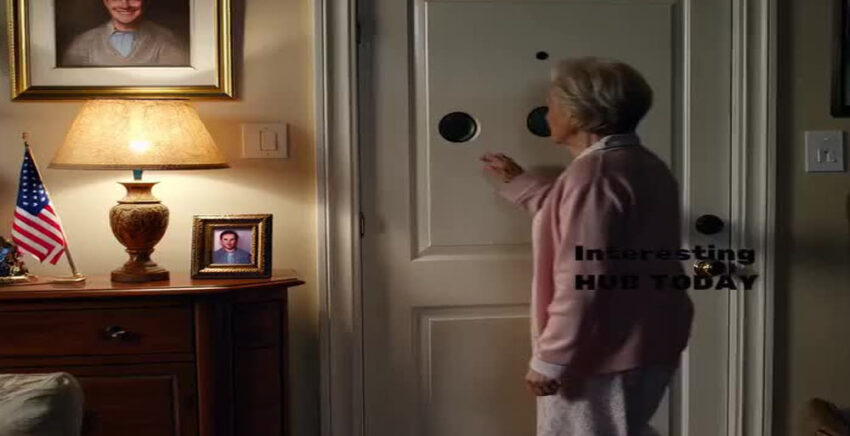
At one o’clock in the morning, in my quiet little suburb outside Columbus, Ohio, the phone rang.
I woke up with a start.
The house was drowned in silence, the kind of deep, American Midwest stillness where even the traffic on the distant interstate feels like a faraway memory. But inside my chest, my heart was pounding like a war drum.
That was when I realized what had dragged me out of sleep.
The phone.
It rang with a sharp, piercing insistence, tearing through the silence of 1 a.m. Stumbling, I got out of bed and grabbed the phone from the nightstand. The blue light of the screen hurt my eyes.
A familiar name appeared.
Mrs. Miller.
She was my widowed neighbor, the elderly lady who lived alone in the small white house directly across the street, the one with the faded American flag on the porch. Mrs. Miller would never call me at this hour unless something truly terrible was happening.
I slid my finger across the screen and brought the phone to my ear, my voice still raspy from sleep.
“Mrs. Miller?”
On the other end, there was no usual greeting. I could only hear ragged, agitated breathing. Her voice finally appeared, trembling violently. It dropped until it became a desperate whisper, as if she had a knife to her throat.
“Eleanor… listen to me. Whatever happens, even if you hear things… do not open the door to anyone.”
The warning stabbed straight into my mind. A shiver ran down my spine.
“What’s wrong, Mrs. Miller? Where are you?” I tried to ask.
But before I could finish the sentence, a sharp screech of static exploded on the line—and then nothing.
The call cut off.
Just at that instant, a dull thud sounded at the front door.
My heart froze. My whole body went rigid.
Two more knocks.
It wasn’t the knocking of someone polite. They were open-handed slaps against the wood, loud, rhythmic, persistent. Each blow was like a hammer directly against my chest.
I tiptoed out of the bedroom. I pressed my ear against the cold wall of the hallway. The sound rumbled through the house, making my whole body vibrate with each hit.
Gathering all my courage, I shouted, trying not to let my voice break with fear.
“Who is it?”
There was no answer.
Only the knocking continued, constant, as if it would never stop.
Fear overwhelmed me. I ran to the foot of the stairs, looked up into the darkness of the second floor, and yelled:
“Steven! Can you hear me? Steven, come down here to Mom!”
Only heavy silence answered me. Normally, even the slightest noise would wake my son. What on earth was happening?
Desperate, I ran to the living room, grabbed the tablet, and opened the security camera app. The screen was completely black, with a cold line of text in the center:
No connection.
I tapped and tapped several times, but it was useless. All four cameras were offline.
I ran to the porch light switch and pressed it repeatedly, but the darkness outside remained solid and unbroken. Maybe the bulb had burned out. I couldn’t even remember the last time I checked it.
Everything was against me.
I was completely isolated—blind and deaf to what was happening right outside my own front door in the middle of the night in the United States of America, where I had always believed I was safe.
Desperate, I dialed Mrs. Miller’s number again, praying she would pick up and tell me what was going on. The phone rang and rang until it cut off by itself.
No answer.
There were no other options.
I dialed 911.
My voice shook; it barely came out as I reported that an unknown person was trying to force the door of my house at number 14 Pine Street.
The operator assured me they would send a patrol car immediately.
Just as I hung up, the knocking stopped.
Suddenly.
That silence was even more terrifying than the noise before. It was a heavy, stretched-out stillness, like a tightrope pulled to the breaking point.
Had they gone? Or had they found another way in?
A strange impulse—a crazy curiosity stronger than fear—pulled me toward the door. My hand trembled as I touched the freezing doorknob. I inhaled deeply, closed my eyes tight, and then slowly brought my face close to the small peephole.
What I saw almost made me scream.
Steven’s face—my son’s face—was pressed right there against the peephole, filling my entire field of vision.
But that was not my son.
It wasn’t Steven with his warm smile and kind eyes that I knew. His eyes were wide open, empty, almost lifeless. The corner of his mouth curved into a strange smile, a hollow grimace with no emotion whatsoever.
And behind him, blurred in the darkness, stood four tall figures.
They wore black robes with hoods that completely covered their faces, standing like stone statues.
I fell backward, hitting the floor hard. I didn’t dare look a second time. That image was too disturbing, too wrong. It burned itself into my mind.
A few minutes later, police sirens began to wail in the distance, growing louder as they turned onto our street. Red and blue lights flashed through the living room window, strobing across the walls.
“Police! Open the door!” shouted a firm voice from outside.
I didn’t dare go down right away. I remained sitting on the floor at the top of the stairs, shaking.
“I’m up here!” I managed to yell. “Help me!”
I heard them talking among themselves and then a loud boom as they forced the front door. The sound of the deadbolt breaking echoed through the house. Heavy boots rushed into the living room. Their flashlights swept everywhere, cutting the darkness into pieces.
“Ma’am, where are you?” asked a police officer.
Only then did I stand up, trembling, clinging to the handrail as I went down.
The front door was completely destroyed, the entrance illuminated by flashlights. But there was no one—absolutely no one—on the porch or in the front yard.
At that moment, the door to my grandson Matthew’s bedroom opened slowly with a small creak.
Jennifer, my daughter-in-law, came out. She was wearing silk pajamas, rubbing her eyes with a sleepy face.
“What’s happening, Mom? What’s all this noise?” she asked.
I tried to explain everything in the middle of the chaos, stammering—Mrs. Miller’s call, the banging on the door, Steven’s face at the peephole, the hooded figures.
The older officer, who seemed to be the chief, looked at me with a kind but distant expression. He glanced at Jennifer and then looked back at me.
“Ma’am,” he said with a calm voice, “maybe you had a nightmare. Sometimes, due to fatigue and age, people can have very vivid experiences or even brief hallucinations.”
I stared at him, stunned.
“Hallucinations?” I repeated.
Jennifer nodded quickly.
“Yes, officer,” she said. “Lately my mom hasn’t been sleeping well.”
Then she turned to me, placed a hand on my shoulder, and added with feigned sweetness:
“It’s okay, Mom. It was just a bad dream.”
But when I looked into her eyes, I didn’t see the sincere concern of a worried daughter-in-law.
I saw something different.
For a brief instant, something cold flashed there—a look that was gone as soon as it appeared.
It was calculation, not compassion.
That night, the officers replaced the door with a temporary lock and took their report. Then they left. Jennifer helped me back toward my room and checked on Matthew before going to bed.
I stayed on the living room sofa, staring at the new, shiny door.
I knew what I had seen was real.
I am not crazy.
I remained motionless on the sofa until the first rays of dawn slipped through the blinds. Sleep abandoned me completely. My whole body ached—not from age, but from tension.
The first thing I did in the morning wasn’t make coffee or wake Matthew up. I put on a sweater, slipped on my slippers, and went straight out into the street.
The morning air was freezing, but I hardly felt it.
My only goal was the faded blue door of Mrs. Miller’s house.
She was the only one who knew something. The only hope I had left to confirm I had not gone mad.
I rang the doorbell. It sounded weak, with interference. No one answered.
I rang again.
And again.
Losing patience, I started banging on the door with my hand. My knocks echoed desperately in the silent American cul-de-sac.
“Mrs. Miller! It’s me, Eleanor. Open up, please!”
A long while passed.
Just when I was about to give up, I heard the click of the latch. The door opened just a crack—enough for me to see one of her eyes and some strands of her gray, disheveled hair.
That eye shone with fear.
She looked at me as if I were a ghost.
“I already warned you, Eleanor,” she whispered hoarsely through the crack. “I did everything I could. Please… don’t drag me into this anymore.”
Her gaze flicked past me, over my shoulder, as if she feared someone might be standing in the shadows of the quiet Ohio street.
“They’re everywhere,” she murmured.
“Who is everywhere?” I begged, trying to put my foot in the door. “Mrs. Miller, please, tell me what happened to my Steven.”
But she just shook her head violently. Panic gave her the strength to push the door shut.
“I know nothing. Don’t look for me anymore.”
The door slammed in my face.
I clearly heard her throw the deadbolt, followed by the metallic sound of a chain.
All doors had closed for me.
I stood there, frozen in the middle of the alley, a sensation of loneliness and helplessness wrapping around me completely.
I returned home with my mind in a blur.
The house was terrifyingly silent. A faint smell of coffee drifting from the kitchen told me Jennifer was already up. But there was no laughter from Steven, no teasing voice from him chasing Matthew around, no warm presence.
The house seemed to have lost its soul.
The first day passed in desperate waiting.
Steven did not come back.
I called him dozens of times. The phone rang and rang until his voicemail picked up.
“Hi, this is Steven. I can’t answer right now…”
I sent him message after message.
Where are you?
Call Mom now.
I’m very worried, Steven.
Not a single response.
The screen remained black and silent.
I went to look for Jennifer. She was watering the plants on the balcony, calm, as if nothing in our American home had shifted overnight.
“Jennifer,” I asked, trying to stay calm, “do you know if Steven went somewhere? He hasn’t come home and he’s not answering his phone.”
She turned around, showing a perfectly acted surprise. She took off her gardening gloves and shrugged.
“Surely he went out for something urgent for work, Mom. Maybe he was in a meeting and his phone battery died. He’s a grown man. Don’t worry so much.”
That phrase—he’s a grown man—hit me like a bucket of cold water.
I tried to believe her. Maybe I was worrying too much.
But the second day also passed with no news from Steven.
Worry turned into real, tangible fear.
I could no longer sit still.
With trembling hands, I dialed the landline number of the company where he worked downtown.
A young voice from reception answered.
“Hello, this is the office. How can I help you?”
“Hello, this is Eleanor, Steven Miller’s mother,” I said. “Sorry to bother you, but I wanted to know if he went to work today.”
There was a moment of silence. I heard the sound of papers.
“Let me check… Ah. Mr. Miller called to report sick and asked for a week of leave, ma’am.”
I felt as if someone had squeezed my heart.
A week.
Steven never took sick leave without telling me. He knew how much I worried.
That was not my son.
That night, I couldn’t take it anymore.
While Jennifer washed the dishes in the kitchen, I walked in and stood right behind her. My voice had nothing sweet left in it; it had turned sharp, like a blade.
“Jennifer,” I said, “tell me the truth. Where is Steven?”
She startled, almost dropping a plate. She turned around and dried her hands on her apron, her expression mildly confused. Then, suddenly, she seemed to remember something. She slapped her forehead lightly.
“Oh—silly me,” she said, in a tone so casual it gave me chills.
While she continued washing the dishes, she added:
“Oh yes. The day before yesterday, he called me when I was at the supermarket. My cell phone was almost out of battery, so we spoke very little. He told me an old friend had come back to town and they organized a last-minute camping trip with the group. He said there’s no signal there. That’s why he asked that no one worry. I’ve been so busy I forgot to tell you. Sorry, Mom.”
I froze.
Every word coming out of her mouth was more absurd than the last.
Steven? Camping?
My son hated camping. He was afraid of bugs, annoyed by mud, and he would never have slept in a cramped tent out in the woods. The last time they forced him to go camping, he was fifteen and complained for an entire month afterward.
I stared at my daughter-in-law, trying to find some sign of a lie—a flicker in her eyes, a hint of nervousness.
But no.
She was completely calm, going about her business as if she had just told an unimportant anecdote. She avoided looking me in the eyes, focusing on placing the dry dishes in the drainer.
That calm—
That chilling calm—
Was more terrifying than Steven’s distorted face at the peephole, more terrifying than those hooded figures dressed in black standing in the dark.
A horrible, freezing suspicion began to grow inside me.
My daughter-in-law Jennifer was not only lying.
She was hiding something.
And I was sure it had everything to do with my son’s disappearance.
Two more days passed.
The house that was once my home had become a silent theater stage.
There, Jennifer was the lead actress, and I was the forced spectator.
She continued behaving with total normality—a normality that was strangely disturbing. She hummed a happy melody while making breakfast. She asked me if I had slept well with a radiant smile. She even complained about the high price of avocados at the market.
Every gesture, every word of hers was perfect.
Jennifer fit the role of an exemplary American daughter-in-law.
But to me, that normality froze my blood.
To keep from losing my mind with so many suspicions, I decided to clean the house. It was my way of clinging to reality, of putting a little order in the middle of the chaos swallowing me.
I started with Matthew’s room.
The boy was playing alone in the backyard. His clear laughter drifted in through the window, clashing with the tension in the air.
His room was full of his small, child-world. I picked up the toy cars scattered on the floor, carefully stacked his superhero comics. I approached his desk where colored pencils and sheets of paper were everywhere.
While I was gathering the sheets to stack them, one drawing caught my attention.
It was different from the usual ones.
There were no superheroes or bright cars. This drawing had been made only with a black crayon.
The crooked, almost trembling lines formed a chilling contrast against the white paper.
I took it in my hands, and my fingers immediately began to shake.
My whole world stopped.
It was a circle.
A circle formed by elongated, deformed human figures with long robes and pointed hoods. They were grouped, all of them facing the center.
And in the center of that circle was another figure—a man—with his arms extended as if he were nailed to an invisible cross.
The face of that man, drawn with the innocence of a child, was just an empty circle with two dots for eyes and a straight line for a mouth.
But it somehow conveyed an empty, soulless expression that froze my blood.
It was identical to the face I had seen through the peephole that night.
Steven’s face.
My heart beat so hard in my chest I feared it would break. The air felt thick; it was hard to breathe.
This was not my imagination.
It was not a nightmare.
It was proof.
Proof drawn by my own innocent grandson.
I clutched the sheet between my fingers and practically ran into the yard.
Matthew was still playing, focused on filling his red plastic bucket with sand. The sunlight reflected on his fine hair.
I forced myself to use the softest voice possible, a voice that wouldn’t betray the terror boiling inside me.
“Matthew, my love, you draw beautifully.” I knelt beside him. “Can I ask you about this one?”
I showed him the drawing.
“And these people… who are they, honey?” I pointed to the robed figures.
The boy didn’t lift his head. He kept playing with his shovel. His voice was clear, innocent.
“It’s Mom’s friends, Grandma.”
An invisible hand squeezed my chest.
“Mom’s… friends,” I repeated, trying to keep my voice steady. “And when do they come to the house?”
“At night,” he answered without looking at me. “When you’re already asleep. They come to play with Dad.”
Play with Dad.
I felt my throat go dry.
“And what do they play, my love?”
“I don’t know.” The boy stopped, scratched his head. “They stand around Dad and say weird things. Mom says it’s a secret adult game. I wanted to play too, but Mom didn’t let me. She told me not to tell Grandma.”
Finally, the boy lifted his head to look at me. His eyes were pure, without a hint of a lie. He smiled, an innocent child’s smile.
“It’s our secret, yes, Grandma?”
Every word of his was like an invisible hammer blow to my skull, leaving me stunned.
“When you’re already asleep…”
Those words echoed over and over in my mind.
Then a memory struck me—sharp, terrifying.
Every night without fail, Jennifer brought me a cup of very hot chamomile tea.
“Here, Mom, so you sleep well,” she always said with a tender smile.
And yes, I slept.
I slept a strange sleep, too deep. I never woke at midnight, which is unusual for a woman my age. Normally older people get up at least once or twice.
I had thought it was exhaustion.
But no.
It wasn’t care.
It was control disguised as kindness.
I forced a crooked smile at Matthew.
“Yes, my love… our secret,” I said.
I stood up and went back into the house.
My head was spinning.
I no longer felt only fear.
Fear had begun to harden into something else—a cold anger and an iron determination.
I took my cell phone, placed the drawing on the kitchen table where the light was good, and photographed it from several angles, making sure it was very clear.
Then I folded the drawing carefully.
I went into my room and hid it between the pages of an old family photo album on the top shelf of the closet—a place where I knew Jennifer would never look.
That night, as if she were a programmed robot, Jennifer brought me tea again.
“Here’s your tea, Mom,” she said.
I smiled as I took it. I thanked her. Her eyes remained clear, her smile just as sweet.
But now I had seen the monster behind that mask.
As soon as she turned around, I walked to the fern pot in the corner of the room and silently emptied the entire cup of hot tea into the soil.
That night, I did not sleep.
I sat in the darkness of my room.
Silence no longer brought peace; it felt like a trap waiting to snap shut.
The fear of the previous days had solidified into a cold and sharp plan.
I couldn’t continue being a fragile, confused old woman.
I had to act.
I had to find proof.
The next morning, when the first rays of sun touched the windowsill, I started my performance.
Trying to get out of bed, I pretended my leg failed me and let out a loud “ouch,” full of pain.
Immediately, I heard Jennifer’s hurried footsteps in the hallway.
She ran in with a perfectly worried face.
“Mom, what happened?”
I was sitting on the edge of the bed, a hand clutching my knee, my face furrowed as if enduring terrible pain.
“Oh, my knees… It must be the weather change last night. It hurts so much. I don’t think I can walk, Jennifer.”
She believed it instantly.
That morning, I was an impeccable actress.
I walked around the house limping with every step, accompanied by a soft moan. I complained about not being able to bend down to get the remote control, about not being able to put on my socks without making a face.
During breakfast, I purposely dropped the spoon and looked at her as if I couldn’t pick it up.
Then I threw out the bait.
“What a nuisance,” I sighed, rubbing my knee. “I remember Mrs. Rose told me her daughter Paula is a very good doctor now. Maybe I should go to her clinic to see what she thinks. Because the way I am… I only end up bothering you.”
Jennifer didn’t suspect a thing.
Her concern came instantly, as if from a script.
“What are you saying, Mom? How are you going to be a bother?” she protested.
She quickly took her cellphone.
“Let me call Paula’s clinic right now to schedule an appointment for you. Your health is the most important thing.”
Her sweet voice now sounded completely fake to me. It screeched in my ears.
She would do anything to keep the image of the perfect daughter-in-law—a flawless facade hiding very dark intentions.
At Paula’s clinic, a clean and bright medical office, Jennifer accompanied me to the waiting chairs.
“Sit here, Mom. I’ll go get your number,” she said.
When she walked away, I raised my voice just enough for her to hear.
“Jennifer, when it’s my turn to go in, stay out here, okay? I’m embarrassed to talk about my old-lady aches in front of my daughter-in-law.”
She accepted, delighted—maybe even relieved to stay outside texting on her phone.
“Sure, Mom. Whatever you want.”
The moment the doctor’s office door closed, separating me from Jennifer, I felt like I was taking off a heavy armor.
I straightened up.
The pain disappeared.
Paula, sitting behind her desk, looked up, surprised.
“Aunt Eleanor… what’s wrong? A moment ago outside, you looked in so much pain.”
Without wasting a second, I walked quickly to the desk, took out my phone, and opened the photo of Matthew’s drawing.
“Look, honey,” I whispered, my voice urgent. “This is what’s really happening.”
In a low but intense voice, I told her everything.
The call in the middle of the night.
Steven’s empty face.
Jennifer’s eerie calm.
The cup of chamomile tea every night.
And Matthew’s drawing.
Paula listened, and her usually smiling face turned serious and firm. She didn’t think I was crazy or exaggerating. She looked deeply into my eyes—eyes dark from sleepless nights—and in them she saw genuine horror and pain.
And she believed me.
“We need proof that no one can deny, Aunt,” she said firmly, with the rational, decisive tone of a doctor. “A drawing made by a child is not going to convince the police.”
She stood up.
“I’m going to draw blood. In the record, I’ll put that it’s to check inflammation for arthritis, but in reality I’ll request a complete toxicology panel. It will detect most known sedatives if they’re in your system.”
While she took the sample, I noticed her hand didn’t tremble at all.
Her steadiness gave me a strange sense of safety.
“I’m going to ask for this to be processed urgently. Maybe this very afternoon we’ll have preliminary results,” she said softly. “When we finish, don’t go straight back home. Go to my mom’s house—Mrs. Rose—and wait there for me to call you. It’ll be safer.”
I left the clinic and went back to acting like a poor lady with joint pain in front of Jennifer. I told her the doctor had taken blood, that we had to wait for the results, and that in the meantime I wanted to stop by Rose’s house to distract myself a little.
The following hours felt eternal.
Sitting in Rose’s living room, my mind spun. She squeezed my hand tightly without asking questions, giving me silent support.
Every time the phone rang, my heart stopped—
Until finally, it was my cell vibrating.
Paula’s name appeared on the screen.
I took a deep breath before answering.
Her voice on the other end was grave, controlled, without a trace of her usual lightness.
“Aunt Eleanor… you were right.”
I held my breath.
My ears rang.
“They found traces of a benzodiazepine-type sedative in your blood,” Paula continued, her voice clinical. “It’s considered mild in controlled doses, but the concentration indicates you’ve been exposed continuously—almost daily—for a long period of time.”
I stammered.
“That means… what does it mean, honey?”
Paula inhaled deeply; I could hear it through the line.
“It means someone has been putting that medication in your food or drink every day for a long time.”
Holding the phone in my hand, I felt a shiver run down my spine.
But at the same time, a strange sense of relief washed over me.
I was not crazy.
What I saw, what I suspected—
It was real.
The proof was no longer just a child’s drawing.
It was in my bloodstream.
Impossible to deny.
There are truths that only speak when everything else goes quiet.
And if you’re listening to me right now, before we continue, I want to ask you something from my heart as part of our little “Elderly Stories” community here in America: check if you’re already following and share in the comments where you’re watching from. It means more than you know—it tells me how far these stories of courage and survival reach.
Now… let’s continue with what happened next.
Rose, my lifelong friend with whom I had shared so many joys and sorrows, was still sitting in front of me, watching every small expression on my face.
She didn’t need to ask.
It was enough to look into my eyes—eyes no longer full of tears, but of emptiness—to understand.
“It’s true, isn’t it, Eleanor?” she asked quietly.
Her voice dropped in tone, heavy.
I could only nod. My throat closed; I couldn’t utter a word. Instead of speaking, I handed her my phone with trembling fingers.
The screen still showed the photo of Matthew’s drawing.
Rose put on her reading glasses and narrowed her eyes to see better. She slid her finger over the little robed figures, over the lifeless face of the man in the center.
She went over the image again and again until suddenly she stopped.
Using two fingers, she zoomed in on a small detail in the corner of the drawing that I, in my panic, had missed.
A symbol.
Matthew had scribbled it next to one of the hooded figures. It looked like an eye between two curved shapes, like crescent moons facing outward.
“My God…” she murmured, bringing a hand to her mouth. The color drained from her face.
“This… this can’t be.”
She got up suddenly, almost running toward the old mahogany bookcase in the corner of the room.
She rummaged through the bottom shelf until she pulled out a yellowed cardboard box, covered in the dust of years. She placed it on the table. The dry thud echoed against the wood.
When she opened it, I saw old folders and newspaper clippings yellowed by time.
“This… this is what Joseph kept after retiring,” she whispered. “The cases he could never forget.”
She turned page after page with trembling hands. Her eyes scanned the letters, the blurry photos, the faded police sketches.
Finally, she stopped on a sheet where a sketch was stapled.
It was the same symbol.
An eye between two crescent curves.
Identical to the one Matthew had drawn.
“The Shadow of Blood,” Rose whispered, and the name sounded like a curse.
“My husband chased this group for almost ten years before retiring. He said they were like ghosts, that they never left a trace—just this symbol—and that they destroyed families.”
Just then, the front door opened.
A tall man with hair streaked with gray stepped inside.
It was Joseph—Rose’s husband, former police inspector, a man who had spent his life working inside the American justice system.
His gaze was sharp as a razor. Despite being retired, his bearing still conveyed the authority of someone who had faced darkness many times.
Rose didn’t need to tell him much. She simply showed him the photo on the phone and the test results Paula had just sent to her email.
Joseph reviewed everything without saying a word.
He showed no surprise or alarm. His face looked concentrated, marked by deep lines of attention.
He paced from one side of the room to the other, hands clasped behind his back like a hunter reading invisible tracks.
Then he stopped and turned toward me.
“Mrs. Eleanor,” he said, “I’d like you to tell me everything from the beginning to the end. Don’t omit even the smallest detail.”
And so I did.
I told him about the knocking on the door.
Steven’s empty face.
Jennifer’s unnerving calm.
The chamomile tea every night.
Neighbor Mrs. Miller’s paralyzing fear.
When I finished, Joseph nodded slowly. He stopped pacing and looked me straight in the eyes.
In his gaze, there was no pity—only understanding and hard truth.
“Mrs. Eleanor,” he said, “I’m sorry to tell you this, but your son is already in their hands. Jennifer is not really your daughter-in-law in the way you believed. She’s a wolf in sheep’s clothing.”
His voice was grave and firm.
“The Shadow of Blood is not a common sect. It’s a sophisticated criminal organization that operates behind a religious façade. They focus on families with some money, people who are emotionally or psychologically vulnerable. They insert one of their own—like Jennifer did with your son. Their members infiltrate, gain trust, become indispensable to the family, and then slowly poison the victim with small doses of sedatives and mind-altering substances.
“They confuse their victims, break their sense of reality, make them believe in strange doctrines about ‘purification’ and ‘surrender,’ and then get them to sign documents to transfer property—houses, accounts, sometimes even guardianship of loved ones.
“The rituals Matthew saw weren’t games at all. They were collective manipulation sessions.”
“So my Steven…” My voice broke; I felt my heart shatter.
“It’s very likely,” Joseph said without hesitation, “that he’s in one of their hideouts right now, being ‘prepared’ for some kind of closing ceremony.”
He took a step closer and placed a firm hand on my shoulder. His look was serious, full of determination.
“We’ve been tracking this group for years, but they’re clever. They constantly change locations and leave almost no trail. But this time… this time is different. This time we have someone inside their circle, whether they realize it or not.”
He squeezed my shoulder gently.
“You,” he said.
“You are the only person who can get close to Jennifer without raising suspicion. If you have the courage… you’re the key to taking down this entire organization and saving your son.”
In that instant, something strange happened inside me.
All the fear, confusion, and helplessness I’d accumulated over these days didn’t vanish—but they changed.
They melted into something forged in fire: a mother’s love and a quiet rage, becoming a cold, solid weapon.
I was no longer just old Eleanor from 14 Pine Street.
I was a mother searching for her child.
I raised my head, looked the former inspector straight in the eyes, and nodded firmly.
“What do I have to do?”
That night, I didn’t return home.
Joseph asked me to stay.
Rose’s warm living room suddenly became an operations center.
Joseph called some of his old colleagues—retired police officers still sharp and loyal. They sat around the coffee table, cigar smoke mixing with the warm lamplight. Their grave, firm voices rose over a map of our city spread across the table.
I sat there—an old woman in a worn sweater—out of place among men with warrior souls. But inside me, a strange calm began to grow.
I was no longer alone in this battle.
The next morning, before the sun came up and before Jennifer woke up, I had already returned quietly to my house.
I put back on not only the old sweater, but also the role of a frail, sick mother.
I limped again, complained about my joints.
When Jennifer asked for the medical test results, I lied without hesitating—a skill I didn’t know I possessed.
“Dr. Paula said some of my health indicators are a little off,” I told her, rubbing my knee. “She drew blood for more tests, but the results will take a few days. Meanwhile she told me I have to rest. Absolutely no outings.”
Jennifer showed herself very understanding—even pleased that I no longer insisted on going out.
“Yes, Mom. Rest easy. Let me take care of everything,” she said.
Just as Joseph had planned, while Jennifer went out to the market, the doorbell rang.
A young man in a telecommunications company uniform was at the door.
“Good morning, ma’am,” he said loudly enough for any curious neighbor to hear. “The company is offering a free program to review and improve internet connections in the neighborhood.”
He was Joseph’s envoy.
In just fifteen minutes, while I pretended to fuss with hot water in the kitchen, he moved with speed and professionalism.
Tiny camera lenses and discreet recording devices were installed in key points:
Inside the wall clock in the living room.
Behind the hallway painting.
Under the dining table in the kitchen.
And especially a camera cleverly disguised in a small ornament, aimed directly at the fern pot where I had been pouring the tea.
He didn’t say much—just gave me a discreet nod before leaving.
My house had become a monitored trap.
The next matter was Matthew.
“The boy can’t stay there,” Joseph had told me the night before with a firm voice. “He’s a witness. It’s too dangerous for him to be near Jennifer. His safety comes first.”
Rose took charge of this perfectly.
She called Jennifer with a cheerful tone.
“Hello, Jennifer! It’s me,” she said. “Listen, this weekend I’m organizing a special little ‘summer camp’ for the grandkids at some friends’ place in the mountains. The air is so fresh up there. There are horses, a creek—it’s going to be fun. I wanted to invite Matthew too so he has company. What do you think?”
Just as Joseph predicted, Jennifer—maybe wanting to have her hands free to execute her own plans—accepted immediately.
“Oh, that’s perfect. Thank you so much, really. He’s been bored being stuck at home,” she said.
That afternoon, I personally packed Matthew’s clothes in his dinosaur-shaped backpack. When I zipped it up, I hugged him tight, inhaling the scent of his children’s shampoo—that innocent, clean smell.
I whispered in his ear, my voice serious but full of affection.
“Matthew, listen carefully to Grandma. Over there, you have to behave well, okay? But remember… don’t say anything to your mom about the picture or about her friends in black. That stays between us. It’s understood? It’s still our secret, agreed?”
The boy nodded obediently. His big eyes looked at me with total trust.
When Rose’s car drove away with Matthew at the end of the alley, I felt an immense emptiness in my chest.
But mingled with that sadness was a huge relief.
My grandson was safe.
Outside, the net was already being spread.
A small truck from an environmental cleaning company appeared, parked on the corner all day. But I knew that inside, a technical team was glued to screens, monitoring every signal from the devices in my house.
Some unfamiliar people started appearing in the neighborhood—naturally.
A man walking his German shepherd every morning.
A young woman pushing a stroller, passing several times in front of my house.
A group of workers repairing the roof of a nearby building.
My street, once so familiar, suddenly felt different.
But I knew they were all undercover officers—my invisible protectors.
That night, only Jennifer and I were in the house.
Without Matthew’s laughter, the atmosphere was more tense than ever.
When she brought me a cup of chamomile tea, I smiled as I received it.
The kitchen light reflected in the eyes of that monster disguised as a caring woman—and I knew it also reflected in the invisible eye of the hidden camera.
I raised the cup, pretended to take a sip, feeling the steam on my lips. Then, while she turned to pick something up, I quickly and silently poured the rest of the tea into the fern pot.
I knew every drop I threw away was being recorded as proof—and it was also an act of resistance.
My performance had truly begun.
During the next two days, I continued playing the role of the sick mother, spending most of my time in the plush armchair with knitting needles in hand.
But in reality, every sense was on high alert.
My ears were attentive to every step, every phone call Jennifer made.
My eyes never stopped observing her movements—from hidden corners, through reflections, and from the angles where I knew the cameras had a clear view.
Joseph had warned me in a brief call relayed through Rose that we needed a golden opportunity—a period long enough for his team to act inside the house without being discovered.
I had to create that opportunity.
I had to be the bait.
The plan was already drawn in my mind—simple, but it had to be executed perfectly.
That morning, while sitting at the table, I took the local newspaper and pretended to read it. Then I stopped at a small notice.
I cleared my throat and read aloud, slowly, as if talking to myself.
“Oh… today there’s a craft fair at South Park. What pretty things… Too bad with these legs I can’t go anywhere,” I sighed, leaving the newspaper on the table with a melancholy gesture.
Jennifer, who was cleaning the kitchen, turned when she heard me. For an instant, her eyes shone with something that looked like calculation—but she quickly hid it behind a kind smile.
“If you want to go, I can take you,” she offered. “We can walk slowly, and if you get tired, we rest. Being locked up in the house all the time isn’t good for you.”
Maybe she thought it was a good chance to keep playing her role as the perfect daughter-in-law.
Or maybe she also needed an excuse to leave the house.
I looked up, feigning surprise and joy.
“Really, dear? Oh, that would be wonderful. I need to clear my head a little.”
At the agreed time, Jennifer drove me to the fair.
When the car slowly left our quiet Ohio street, I took a quick look in the rearview mirror.
An orange garbage truck was parked at the end of the block—earlier than usual. The worker beside the vehicle held a broom, but he wasn’t looking at the ground.
He was looking straight at our car.
Then he nodded slightly.
The gesture was almost imperceptible.
A shiver ran down my spine.
It was the signal.
The plan had begun.
At the fair, I turned into the pickiest, most curious old lady in the place.
I stopped at every stall—from ceramics and embroidery to handmade silver jewelry. I picked up every object, examined it in detail, asked about its origin, about how it had been made.
In truth, I didn’t care about any of it.
But every second I kept Jennifer there was a second Joseph’s team had to work.
Jennifer started to get impatient, but she had no choice except to keep smiling and waiting.
After almost an hour, I insisted on sitting to rest at a small stand selling drinks.
I ordered a strawberry smoothie and drank it very slowly, sip by sip, as if it were the best elixir in the world.
I knew every minute I kept Jennifer occupied was valuable.
Almost two hours later, when she could no longer hide her nervousness, I finally agreed to go home.
On the way back, I stayed silent, my heart beating a thousand times a minute.
Had they found anything?
Had everything gone well?
When we arrived, everything looked as calm as when we had left.
No sign of forced entry.
The dishes were still in the sink, the kitchen towel hanging on the edge.
Joseph’s team had been too professional to leave a trace.
That night, after discreetly emptying my tea once again into the fern pot, I received a message from an unknown number:
See you in the usual place.
I waited for Jennifer to go into her room. Then I put on my coat and said aloud that I needed a short walk to stretch my legs.
I took a long route before slipping toward Rose’s house.
Joseph was already waiting for me in the living room. His face was tense, but in his eyes shone an unmistakable spark of triumph.
“Did you find anything?” I asked as soon as I sat down, without any greeting.
He placed an object carefully wrapped in a police evidence bag on the table.
Through the plastic, I saw a small notebook with a dark brown leather cover and worn corners.
“It was very well hidden,” Joseph explained. “Under a loose floorboard right under Jennifer’s bed—a place only someone who sleeps in that room would know about.”
He pointed to the notebook cover.
It had a symbol engraved on it—an eye between two crescent-moon shapes.
Joseph put on gloves and began turning the pages slowly.
Inside were lines written in red ink, full of strange symbols, dates, and names.
Some pages described herbal formulas and chemical substances. I shuddered, realizing that maybe one of those combinations was the mixture she had been giving me.
There was also a list labeled “hosts already prepared,” with estimates of their assets.
They were names I didn’t know—families unrelated to me.
But in that moment, I felt a tragic kinship with every single one of them.
It was the last page that left me paralyzed.
Under a title written in large, unsettling letters—FINAL PURIFICATION CEREMONY—there was a line written in clear, neat handwriting:
Offering: Steven Miller
Time: 00:00 hours
Date: Friday, December 1
Place: The Ravine
My blood ran cold.
I looked at the calendar hanging on Rose’s wall.
Today was Wednesday.
We had two days.
Two days to save my son from a terrifying ceremony.
“Where is ‘the Ravine’?” I asked, my voice trembling.
“It’s an old canyon on the outskirts of the city where there used to be a mine,” Joseph answered. “It’s been abandoned for years. A perfect place to do dark things without anyone noticing.”
He looked at me with determination, but also with deep compassion.
“Now we have everything—the time, the place, and written proof.”
He paused and then said each word like a hammer blow.
“It’s time to lower the curtain.”
On Friday night, under a full moon hanging over Ohio like a white coin, the air in the house was so thick it could almost be touched.
Jennifer seemed more restless than usual. She kept glancing at the wall clock, twisting the edge of her blouse with her fingers, occasionally peeking through the window as if expecting something.
She no longer hummed while cooking.
The house was unsettlingly quiet.
At nine o’clock, right on time, she brought me my chamomile tea.
But this time, she didn’t just leave it on the table and walk away.
She stayed there, watching me.
“Drink it early and get some rest, Mom,” she said. “You look a little tired today.”
Her voice had something different—a disguised urgency.
I took the teacup. My old hands were completely steady.
I looked her straight in the eyes, trying to sketch a final smile—a smile that would end this tragic play.
“Thank you, dear,” I said.
I brought the cup to my lips, pretending to drink, letting the familiar aroma of chamomile—now the smell of betrayal—fill my nose.
Then, while she turned around, I repeated the gesture that had become routine.
I emptied the rest into the fern pot.
This time, the faint medicinal scent in the air seemed even stronger.
But it didn’t make me sleepy.
If anything, I felt more awake than ever.
I went up to my room, pretended to yawn, wished her good night, and turned off the light.
I did not sleep.
I sat on the bed in the dark, ears tuned to any sound, no matter how small.
My heart beat hard—not from fear, but from expectation.
At eleven o’clock sharp, I heard a floorboard creak downstairs.
I narrowed my eyes and looked through the crack in the bedroom door.
A silhouette moved in the hallway.
Jennifer, dressed in black from head to toe, slipped silently toward the front door.
It opened and closed softly, almost without a sound.
The snake had left its nest.
As soon as I heard her car engine start and pull away, I jumped out of bed.
I didn’t waste time changing clothes. In my flannel pajamas, I ran downstairs, cracked the door open, and stepped out into the freezing night air.
A dark sedan with its headlights off rolled up and stopped right in front of me.
The back door opened.
Joseph was at the wheel. In the dim light, his face looked carved from stone.
“Get in, Mrs. Eleanor,” he said.
We followed Jennifer’s car at a safe distance, guided only by the red glow of her tail lights.
We left the lit neighborhoods of our American city behind and took the highway. Then, suddenly, she turned onto a narrow dirt road full of potholes, cutting across dark, empty fields on the outskirts.
The car bumped constantly, but I barely noticed.
My eyes were fixed on that red dot in the distance.
Finally, that dot stopped.
Her car parked near the edge of a deep ravine, completely swallowed by the darkness.
The Ravine.
Further ahead, a path led to a cluster of old, run-down buildings—like an abandoned mining station from another era.
But that night, one of those buildings glowed with the red light of candles, projecting deformed, ghostly shadows that danced on the rocks.
Joseph turned off the engine and we hid behind some bushes.
He handed me a pair of binoculars.
Through the lenses, my hands began to shake as I saw the scene below.
More than twenty people in black robes had formed a large circle in the courtyard.
In the center, tied to a rotting wooden post, was Steven.
My son.
He was dressed in a thin white garment, his head hanging against his chest. He looked like an empty figure—a body without a soul.
Jennifer walked forward and joined the circle in silence.
One of the robed figures, who seemed to be the leader, wore a taller hood than the others. He began to recite strange phrases, his voice rolling across the night in a chilling, inhuman tone.
Joseph grabbed his radio.
“All teams in position,” he said. “Wait for my signal.”
Then he looked at me.
“Are you ready?”
I nodded, squeezing my hands together so tightly my knuckles turned white.
Below, the leader lifted a shiny ceremonial dagger. Its blade reflected the full moon, cold and deadly.
He began to approach Steven.
In that instant, Joseph shouted into the radio, his voice tearing through the darkness.
“Now!”
The night exploded.
Powerful spotlights from hidden police vehicles lit up all at once, flooding the courtyard with blinding white light.
Sirens howled from every direction.
“Police! Everyone, hands up!”
The hooded figures scattered like ants when their nest collapses under a floodlight.
They screamed, tripped over each other, tried to run.
Uniformed officers and undercover agents stormed in from all sides.
Jennifer was taken down by two agents just as she tried to climb a barbed-wire fence at the back.
The leader’s dagger fell to the ground with a metallic clatter.
I didn’t pay attention to anything else.
I threw the car door open and ran down the dirt and stone path, not caring about the cold or the pain in my feet.
My whole being was focused on the white silhouette in the middle of the chaos.
I ran to Steven and with trembling hands untied the rough ropes binding him.
I hugged his thin body. I felt him shivering.
“Steven, it’s Mom. Are you okay, son?”
Slowly, he lifted his head and looked at me.
His eyes were cloudy and distant. A long time passed before he blinked.
Then he blinked again, as if waking from a long nightmare.
A tear slid down his hollow cheek.
“Mom…” he whispered, his voice weak and broken.
But it was the most beautiful sound I had heard in my entire life.
The operation was a success.
The night of horror at the ravine was over.
It gave way to the pale, cold light of fluorescence at the police station.
I was sitting in a small observation room, separated from the world by tinted glass.
On the other side, in the interrogation room, one of the key members of the sect—a thin man with wild eyes—was telling everything.
Joseph sat next to me in silence. His presence was a firm anchor in the emotional storm shaking me.
Every confession from that man was another piece of a disturbing puzzle. When I put them all together, the picture was even crueler than I had imagined.
It turned out that their original plan was to carry out the closing ceremony for Steven in my own house—in his room.
They had already done several “rehearsals” on previous nights when I fell into that unnatural sleep because of Jennifer’s tea.
That was what Matthew had seen and drawn.
Their “secret adult game.”
They wanted to turn our home into an altar.
However, even though they had already neutralized me with sedatives, they still didn’t feel safe.
Our house was in a populated residential neighborhood in the United States, with neighbors just a few yards away on each side. A strange noise or a light at the wrong time could raise suspicions—especially considering the group had already been on law enforcement’s radar before.
So, at the last minute, they decided to move Steven to a more isolated hideout at the ravine.
But on that first awful night, something unexpected happened.
Matthew had a very high fever.
Jennifer, still playing her role as a perfect mother, couldn’t leave him without raising suspicion.
The plan was delayed.
The other members, desperate and unable to contact her, decided to take a risk and return with Steven to the neighborhood. They didn’t plan to enter the house—only to give her a signal and see what was happening.
And that was when Mrs. Miller, with her insomnia, looked out the window and saw them.
A group of hooded figures leading Steven—blank-eyed—down the street.
Terrified, she called me immediately and warned me not to open the door.
When I looked through the peephole, the face pressed against it wasn’t actually Steven.
It was one of the cult members trying to see inside, while others kept Steven back out of sight.
My sudden appearance at the peephole, followed by my call to the police—which they partly overheard—terrified them.
They realized they had been exposed.
They rushed Steven away and disappeared into the dark.
Jennifer, meanwhile, after lowering Matthew’s fever, continued playing her role perfectly.
She denied everything.
She tried to convince me I was having hallucinations, hoping to hide the truth and buy time for her accomplices.
She never imagined that her exaggerated calm—her too-perfect performance—would be exactly what ignited my suspicion and brought everything down.
Steven was taken directly from the ravine to the hospital.
My son—the healthy, full-of-life man I remembered—was now pale with sunken eyes. There were moments when he simply sat for hours, staring at nothing.
The psychologist said he had suffered severe shock and serious emotional trauma due to the intense manipulation and the high doses of hallucinogenic substances.
The recovery process wouldn’t be quick.
It would be hard.
But then the doctor looked at me with an expression full of empathy.
“The fortunate thing,” he said, “is that a mother’s love brought him back just in time. He still has his sense of self. Deep down, he still feels there is hope.”
A few months later—when time, which had seemed frozen, began to move again—the trial took place.
The whole neighborhood was buzzing.
My house, once just another home on a quiet American street, had become the focus of media attention.
Jennifer, along with eight other leaders of the Shadow of Blood, sat on the defendants’ bench.
They faced multiple charges: kidnapping, unlawful imprisonment, financial fraud, intentional harm, and directing a criminal organization.
I was seated in the first row reserved for the victims’ families.
Behind me, whispers, camera clicks, curious murmurs flowed—but I heard nothing.
My attention was fixed on the back of the woman who once called me “Mom.”
When the sentence was read—prison terms so long that they would spend the rest of their lives behind bars—absolute silence fell over the courtroom.
I looked at Jennifer.
As if compelled, she turned to look at me.
Our gazes met across the space between two rows.
In her eyes, I saw no regret, no pain, not even a trace of guilt.
Only a terrifying emptiness.
And shining inside that emptiness, a small spark of hatred.
A hatred aimed at me—the person who ruined her plans.
Slowly, I turned my head away.
There were no tears.
No feeling of victory.
No anger left.
Only a coldness reserved for someone who once ate at my table, tucked my grandson into bed, and then tried to destroy my family from the inside.
As soon as the courtroom door closed behind Jennifer and her accomplices, I knew I couldn’t go back to that house.
I put it up for sale almost immediately.
I couldn’t live there one more day.
I couldn’t breathe that air filled with betrayal and fear.
That house was no longer a home.
It had become a silent witness to the worst season of my life.
Every corner seemed to whisper memories:
The shrill doorbell at midnight.
The brutal banging on the door.
The ghostly image through the peephole.
All of it had become an indelible scar.
We left that noisy city, full of prying eyes and whispered pity.
With the money from the sale of the house and part of my lifetime savings, I bought a small home in a quiet coastal town on the American coast, where Steven’s childhood memories were still bright and clean.
It was the place where I’d taken him on vacation when he was little, where he saw the ocean for the first time and laughed when the Atlantic waves touched his feet.
Our new house was simple: white walls like shells, a blue tile roof like the sea, and a small wooden balcony facing the open water.
The change of environment worked like medicine.
The fresh, salty air seemed to wash away the old nightmares.
The constant sound of the waves replaced the terrible noises that used to haunt my nights.
Matthew, after working with kind therapists for a while, laughed again. His laughter was no longer timid, but clear and loud.
He no longer drew dark figures or circles.
Now his sheets were full of bright colors and life:
Sailboats with white sails.
Playful dolphins jumping over the waves.
White clouds drifting across a bright blue sky.
Darkness had left my grandson’s tender soul.
And Steven—my son—was coming back to life little by little, like a dry tree sprouting leaves after a harsh winter.
At first, he didn’t talk much.
But he acted.
He spent his days turning the soil, transforming the dry backyard into a small garden full of aromatic herbs and rows of wild daisies.
His hands, once used to a computer keyboard, became rough from the shovel and hose.
He started reading again—but not financial reports.
Now he read novels about the sea, about journeys to distant lands.
Sometimes he went fishing with the local fishermen.
His skin tanned under the American sun and ocean wind, and in his eyes, that empty look I’d seen before was gone.
Life had returned.
Sometimes on weekends, Rose and Joseph drove up to visit us.
We sat on the balcony, drank tea, and watched the sunset over the water.
“You know something, Eleanor?” Joseph said once, staring at the horizon. “Thanks to the notebook we found in your house and the testimony from that night, the authorities managed to dismantle several other branches of the group. Many more families were spared from living a tragedy like yours.”
His words lifted a little of the weight on my chest.
At least our pain had served a purpose.
It had lit a warning light for others.
Every morning, I get up early, before the sun rises.
I am no longer afraid of the dark.
I no longer jump at every nighttime sound.
I walk barefoot to Steven’s little garden and pick fresh mint leaves, still covered in dew.
I prepare a pot of tea—not that poisoned chamomile from the past, that tea of deceit and control.
This is my tea.
The tea of a new beginning, with the fresh taste of the earth and my son’s effort.
I pour myself a cup, take it to the balcony, and sit quietly, looking at what I have in front of me.
On the golden sand below, Steven and Matthew are building a sandcastle together.
Matthew’s bright laughter mixes with the murmur of the waves, creating a quiet symphony of peace.
Steven, with a calm smile that has finally returned to his face, shows his son how to make the towers stand tall.
The sound of the banging on the door at one in the morning will always be part of my past.
A nightmare I managed to survive.
That scar will never disappear completely.
But now, seeing my son and grandson safe under the light of a new day, surrounded by love and the steady sound of the ocean, I know that nightmare didn’t win.
It didn’t take away what matters most.
We found our own dawn.
I walked through the worst darkness and survived to tell my story—not as a victim, but as a mother who did not give up.
I came to doubt my own memory.
I was labeled paranoid.
I stood alone among wolves disguised as family.
But it was a mother’s instinct—and faith that the truth still matters—that guided me step by step through the dark.
I want to speak to everyone who might be enduring something in silence, especially inside their own home.
Don’t stop asking questions.
Don’t let a fake calm silence your intuition.
And don’t lose your own voice.
The most dangerous villain is often the one who knows how to act like the perfect good person.
Trust your instincts.
If one day you feel that everything around you is too quiet, too tidy, too perfect… maybe that’s the moment to start listening to yourself again.
Because sometimes, silence is the loudest voice of the truth.
The names and places in this story have been modified to protect the identity of those involved. We don’t share this to judge anyone, but with the hope that someone listening will pause and reflect.
How many mothers are enduring in silence inside their own homes?
I truly wonder: if you were in my place, what would you have done?
Would you choose to stay silent to keep the peace… or would you dare to face everything to recover your voice?
I want to know your opinion on this story from Elderly Stories, and any suggestion you have so we can keep improving our content.
May God bless you, and I firmly believe courage will always lead us toward better days.
And now, as always, when this story ends, somewhere out there another one is beginning. If you stay with us, I’m sure the next one will surprise you too.
Thank you for staying with me until this moment.